Samhain to Halloween: How a Fire Festival Became Date Night
By Lark Devon ·
halloween history, samhain, crack nut night, robert burns, ronald hutton, nicholas rogers, folk courting, lanterns glow
Written by Lark Devon, author of adult fantasy romance where the research shows. Published October 30, 2026.
Short answer: Halloween has carried seasonal, religious, communal, and playful meanings that varied across Scotland, Ireland, England, and later North America. Scottish and Irish sources do record courtship and divination games, including hazelnut and apple-peel customs, but it is too broad to call Halloween everywhere an adult matchmaking festival. Samhain is a Gaelic seasonal term associated with summer's end; the later holiday history is layered rather than a straight line.
Did people really use Halloween to find out who they'd marry? I love this one, because it turns the spookiest night of the year into a party where a pair of hazelnuts gives you an excuse to flirt.
Modern Halloween means blood-splattered haunted houses, masked killers in slasher movies, plastic bats, and kids collecting chocolate bars.
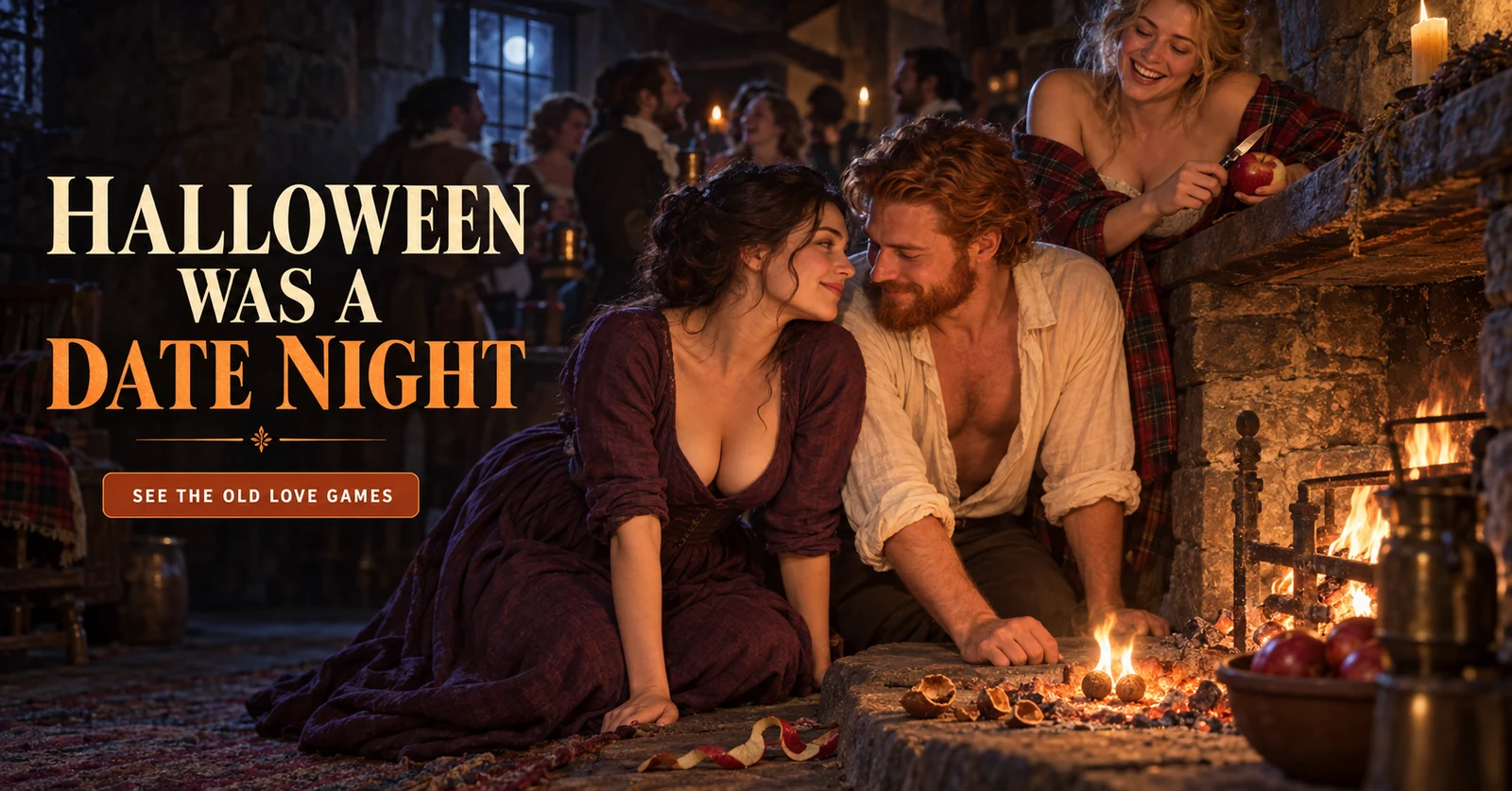
In some eighteenth- and nineteenth-century Scottish and Irish accounts, October thirty-first included love games and divination as well as feasting, mischief, and supernatural stories. Those customs could make it a lively, flirtatious night in some communities.
Some places called it "Crack-Nut Night" or "Nutcrack Night." Young men and women gathered in crowded, candlelit parlors to play kissing games, sneak out into dark vegetable gardens, and use hearth embers to find out who they were going to marry.
The Celtic Roots: Samhain and the Winter Threshold
In Gaelic Ireland and Scotland, the year was divided into two primary seasons: summer (samrad) and winter (gemred).
The festival of Samhain (celebrated around November 1) marked the threshold:
- The Pastoral Gathering: Cattle and sheep were brought down from high summer pastures to warm lowland barns, and the community gathered to slaughter excess livestock and preserve meat for winter.
- The Fire Tradition: Fires and communal gatherings are documented in later accounts, but the evidence does not establish one uniform ancient rite in which every household extinguished and relit its hearth from a single bonfire.
- The Liminal Opening: Medieval Irish literature and later folklore associate Samhain with supernatural encounters. The popular phrase "thin veil" is a modern summary, not a single ancient doctrine shared by every community.
In the eighth and ninth centuries, November 1 became established as All Saints' Day (All Hallows). All Souls' Day, on November 2, spread later from the abbey of Cluny; the Vatican dates Abbot Odilo's institution of it to 998. With All Hallows' Eve, these observances formed the three-day season of Allhallowtide. The fire and supernatural themes, meanwhile, show up unevenly across later sources and regions.
Crack-Nut Night: The Matchmaking Fire Games
In some accounts, people played games on Halloween to imagine or divine who they would marry.
Scottish national poet Robert Burns wrote "Halloween" in 1785, and it was first published in 1786. The poem and its notes describe games rural Scots played that night, and other folklore records add more:
- Nut Burning (The Fidelity Test): A young woman would place two hazelnuts side by side in the glowing hearth embers: one named for herself, and one named for her suitor.
- If the nuts burned quietly together, the courtship was supposed to go well.
- If one started away from the other, the courtship was in trouble.
- Apple Peel Tossing (from Irish folklore records, not Burns): A girl peeled a red orchard apple in a single, unbroken ribbon and hurled the peel over her left shoulder onto the floor. Everyone in the room studied the shape of the fallen peel for the initial of her future husband.
- Kale Pulling: Young men and women went out hand in hand with their eyes shut and pulled the first cabbage or kale stalk they touched. The stalk's size and shape foretold the future spouse's stature, while the taste of the custock, the heart of the stem, predicted their temperament (sweet or bitter).
These party games gave young people a reason to flirt and hold hands in the dark.
The Mirror at Midnight: Romantic Divination
For anyone who wanted a more serious answer, Halloween offered solitary divination rituals:
- The Midnight Apple and Comb: A young woman stood alone in a dark bedroom at midnight, lighting a single candle before a vanity mirror. As she ate an apple, and in some versions combed her hair, tradition held that the face of her future husband would appear in the glass, peering over her shoulder.
- The Sowing of Hempseed: Young lovers walked alone through dark churchyards or pastures at midnight, scattering hempseed behind them while chanting: "Hempseed I sow, hempseed I sow, let him that is to be my love come after me and mow." Looking back over their shoulder, they hoped to catch a ghostly glimpse of their future spouse.
Marriage decided a person's money and home for life, so I don't blame anyone for wanting a sneak peek. Like the party games, they varied by region and from one folklore collection to the next.
The Transatlantic Rebrand: From Romance to Horror
How did these customs change in North America?
- Transatlantic Migration: Irish and Scottish migration helped carry Halloween customs to North America, where they mixed with existing local traditions.
- Civic and Commercial Change: In the twentieth century, schools, towns, newspapers, retailers, and community organizers reshaped the holiday, including parades and organized trick-or-treating.
- Popular Horror: Film, television, and commercial culture amplified Halloween's frightening imagery on top of an already mixed holiday.
I went in hoping Halloween had been a flirting holiday all along. It was in some places, for some people, and I'll take it.
Myth vs. Reality: The History of Halloween
| Pop-Culture Halloween Myth | Archival & Folklore Reality |
|---|---|
| Halloween Was Always About Scary Ghouls | Regional sources preserve feasting, supernatural stories, mischief, and courtship games side by side. |
| Samhain Was an Ancient God of the Dead | Samhain is a Gaelic seasonal term associated with summer's end; treating it as one universal deity oversimplifies the evidence. |
| Nut Burning Was a Dark Occult Curse | Hazelnuts were thrown into hearth fires as a playful parlor test of marital harmony. |
| Ancient Celts Went Trick-or-Treating | Modern trick-or-treating developed in North America, with several proposed predecessors, including souling and guising. |
| Victorian Halloween Was Chaste and Somber | Some Victorian accounts describe flirtation and divination games, alongside many other kinds of celebration. |
Hazelnuts in the fire, apple peels over the shoulder, and a small inn where the whole town comes to find out who it'll end up with. Lantern's Glow is on Lark Devon. Start reading →
How I Used This in Lantern's Glow
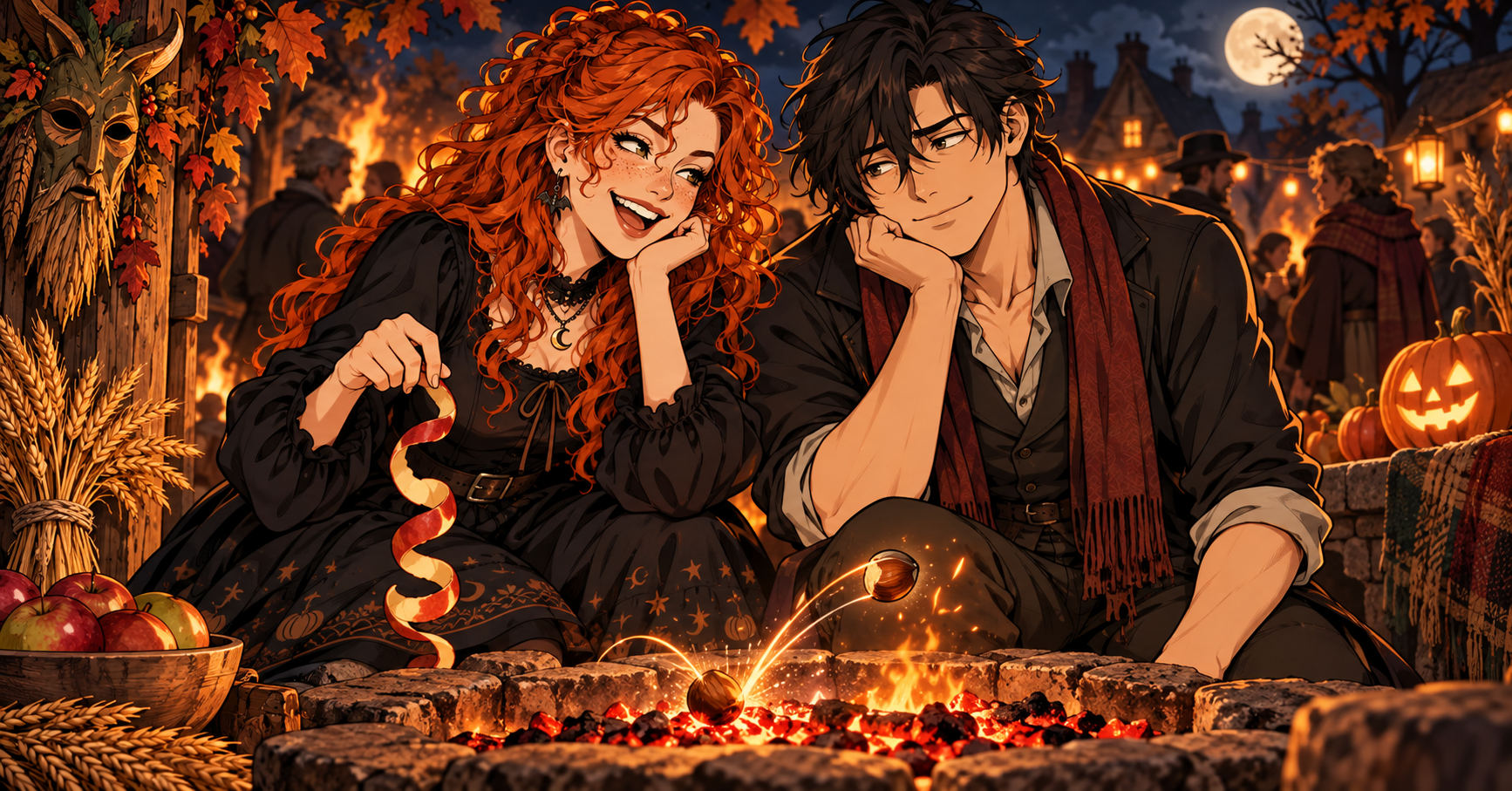
I wanted a cute meeting with a little paranormal in it, not a horror story, so finding the Scottish and Irish records of Halloween courtship games was a nice surprise. Paired hazelnuts in the fire and an apple peel tossed over the shoulder are about as sweet as Halloween gets.
My version is a small New England inn: a costume party with pumpkin carving in the side parlor, cider on the sideboard, paper bats everywhere, and a brass lantern on the library mantel that the town credits with its marriages. Caitlin decorates the whole inn every October and usually spends the party behind a stack of paper plates, watching the game happen to everybody else.
The hazelnut game is two nuts in the fire, and you watch whether they burn together or jump apart. I gave Caitlin and Liam a pumpkin instead: one lopsided gourd, two scoops, a child offering advice, and their hands meeting in the middle.
What Caitlin Thinks
Caitlin is the Glensford town librarian, and she decorates the Willow Inn every Halloween. Hand her the research. This is what you get.
Two hazelnuts in the fire, one for you and one for the person you're hoping for. If they burn together, it's love. If one jumps out, well. I have questions about the sample size, but I respect the drama.
At the Willow Inn we carve pumpkins instead. It's the same game with more knives. Ms. Hawthorne tells you there's room for both of you at the big pumpkin, and then she walks off, and you and whoever's standing next to you are now in a relationship with a gourd.
The apple peel trick is supposed to spell your future spouse's initial. I tried it at sixteen and got something that was either a W or a snake. I've been suspicious of W's ever since.
This year there's a visiting illustrator at the party dressed as a phantom artist, which means he wore a tailcoat and carried his sketchbook and did absolutely nothing to hide his face. I'm bringing hazelnuts. For research. I'm the librarian. I'm allowed.
I traced Halloween from Samhain to date night and ended up at a pumpkin table in a small inn. Lantern's Glow is on Lark Devon. Meet Caitlin and Liam.
Related Questions
Why was Halloween called "Crack-Nut Night"?
In eighteenth- and nineteenth-century Scotland, Ireland, and northern England, Halloween was known in some places as "Crack-Nut Night" or "Nutcrack Night" because young courting couples threw pairs of hazelnuts into hearth fires to divine whether their romantic relationship would burn steadily or crack apart.
What was the original meaning of Samhain?
Samhain is a Gaelic seasonal term traditionally associated with summer's end and the transition into winter. The details of its rites and meanings vary across medieval texts, later folklore, and modern reconstructions.
How did Robert Burns document Halloween courting games?
In "Halloween", written in 1785 and first published in 1786, Robert Burns described rural courtship rituals in verse and explanatory notes. These include hazelnut burning and kale pulling in dark gardens. Apple-peel tossing is recorded separately in Irish folklore.
What was the kale-pulling custom on Halloween?
In traditional Scottish folklore, unmarried youths went out with their eyes shut into dark garden patches to pull up cabbage or kale stalks. The stalk's shape, height, and root soil were believed to predict the physical stature, wealth, and sweet or sour disposition of their future spouse.
Related Reading
- Love Magic in the Records: What the Trial Records Show
- The Witch Trials Weren't About Magic: What Historians Found in the Archives
- Familiars: Why the Witch Gets a Cat
- Tarot Was a Card Game for Centuries: How It Became Divination
- Does Astrological Compatibility Predict Anything? The Studies Exist
- The Grimoire Trade: Who Actually Owned Spellbooks?
- Cunning Folk: The Village Magic Workers History Forgot
Sources
- Hutton, Ronald (1996 / 2001). The Stations of the Sun: A History of the Ritual Year in Britain. Oxford University Press. ISBN: 978-0192854483. Scotland.org historical overview.
- Rogers, Nicholas (2002 / 2003). Halloween: From Pagan Ritual to Party Night. Oxford University Press. ISBN: 978-0195146912.
- Morton, Lisa (2012 / 2019). Trick or Treat: A History of Halloween. Reaktion Books. ISBN: 978-1789141580.
- Burns, Robert (1785 / 1786). "Halloween", in Poems, Chiefly in the Scottish Dialect. Kilmarnock.
- Hutton, Ronald (1991). The Pagan Religions of the Ancient British Isles: Their Nature and Legacy. Blackwell. ISBN: 978-0631189466.