Hades and Persephone: How a Kidnapping Myth Became Romance's Favorite Retelling
By Lark Devon ·
hades and persephone, greek mythology, dark romance, myth retellings, persephone, romance tropes

Written by Lark Devon, author of adult fantasy romance where the research shows. Published November 6, 2026.
Short answer: Modern retellings often recast the Hades and Persephone myth as a story of agency and sovereignty, a sharp contrast with the abduction narrated in the Homeric Hymn to Demeter. The pomegranate and the Underworld can become symbols of chosen belonging, though those meanings belong to later interpretation rather than the ancient text alone.
I spent an afternoon in the National Archaeological Museum of Magna Graecia in Reggio Calabria standing before a fifth-century BCE terracotta plaque from Locri showing Hades and Persephone enthroned side by side, holding their offerings. They look straight ahead with severe, impassive expressions, ruling the dead together.
In the ancient Greek world, nobody thought of their story as a cozy romance.
In the late-seventh- or early-sixth-century BCE Homeric Hymn to Demeter, the myth is an unsparing tale of patriarchal abduction, divine property deals, and catastrophic maternal grief. Zeus secretly grants his daughter to his brother without asking Demeter, and Hades tears open the earth with his golden chariot to snatch the screaming girl from a meadow.
Yet today, Hades and Persephone is one of modern romance's favorite myths to retell. From BookTok blockbusters to adult dark fantasy, millions of readers crave the story of the innocent flower maiden descending into the shadows to become the Dread Queen of the Underworld.
How did an ancient kidnapping myth transform into a modern fantasy of romantic empowerment?
The Ancient Source: The Brutal Homeric Hymn to Demeter
To understand how drastically the story has shifted, you have to read the oldest surviving Greek text: the Homeric Hymn to Demeter, composed around 600 BCE.
In the ancient narrative:
- The Maiden: The hymn calls her both Persephone and Kore, which means "the Maiden" or "the Girl." The girl-word marks her as an unmarried daughter whose future is decided by others.
- The Deal Between Men: Hades (Aidoneus) does not woo her. Zeus gives his consent in secret. Hesiod's Theogony already states the arrangement in two lines: Aidoneus carried her off, and Zeus gave her to him.
- The Abduction: While Kore reaches for a hundred-headed narcissus flower, the earth splits open. Hades drags her down weeping and wailing into the subterranean dark.
- Demeter's Wrath: Demeter is a devastated mother who strikes the earth with a cosmic famine that threatens to starve mankind until Zeus is forced to yield.
The hymn links the story to agriculture and the Eleusinian rites. It can invite comparison with marriage practices in the ancient Greek world, but it does not by itself prove a single social model or that teenage brides were routinely handed to unknown older men everywhere.
The ancient hymn depicts an abduction arranged by male authority, and it gives Persephone no romantic consent before the descent.
From Kore to Dread Queen: The Evolution of Agency
Why did modern writers fall in love with this specific story?
Because ancient Greek religion contained a fascinating contradiction: once she was in the Underworld, Persephone was never a victim.
In later poetry and cult contexts, Persephone could be approached as a powerful Underworld queen, alongside names and epithets that vary by source. "Dread Persephone" is a translation choice for one such epithet, not proof of one uniform cult practice.
Her authority shows up in the old poems. In the Odyssey, Odysseus credits Persephone with sending up the shades of famous women, and he leaves in fear that she will send the Gorgon's head after him. In Ovid, Orpheus sings his plea to both rulers of the dead. Later readers built on scenes like these to make her the Underworld's real power.
Modern dark romance seized on this transformative arc:
- The Escape from the Golden Cage: On Mount Olympus, Persephone is smothered by overprotective rules, expected to be a decorative, smiling maiden who picks flowers forever.
- The Descent as Initiation: Stepping into the Underworld is a psychological katabasis (the hero's descent into the shadow).
- The Acquisition of Power: In the dark, she sheds the childish identity of Kore and steps into her true authority as a queen.
Modern romance often interprets the descent as female maturation and sovereignty, a creative reframing by modern writers.
The Pomegranate Seed: Coercion vs. Deliberate Pact
In the Homeric Hymn, Hades secretly gives Persephone pomegranate food before her return, and the text ties that eating to her divided year.
Before Hermes can escort Persephone back to the sunlight, Hades secretly gives her pomegranate food (kokkos). The hymn says she must spend part of each year below, commonly rendered as one-third, though details and interpretations vary across ancient versions.
In modern retellings, the meaning of this moment changed:
Many modern authors make eating the seed an act of conscious choice.
In those retellings, Persephone eats the fruit with wide-open eyes and claims the meaning for herself. That is a modern narrative choice; the hymn states no such contract.
The seed is her passport. It ensures that for part of the year, she is completely beyond the reach of everyone who tried to control her.
Retellings often turn the pomegranate into a symbol of deliberate choice, while the ancient narrative leaves the scene ethically unsettled.
| Metric | The Ancient Greek Myth | The Modern Romance Retelling |
|---|---|---|
| Hades' Character | Stern chthonic god executing a property transaction. | Devoted dark sovereign who treats his partner as an equal. |
| Persephone's Role | Passive victim (Kore) claimed by patriarchal right. | Autonomous woman claiming her power as Dread Queen. |
| The Underworld | Grim, joyless realm of dust and shades. | Sensual, opulent sanctuary of shadows, wealth, and freedom. |
| The Core Conflict | Mother's grief vs. cosmic natural order. | Autonomy and passionate choice vs. societal expectation. |
A governor keeps his daughter behind paper walls. A pirate burns them down and leaves the final choice in her hands. Start Porcelain →
Why Hades Beats Olympus: The Appeal of the Dark Sovereign
The final key to the trope's dominance is the character of Hades himself.
In Greek mythology, the Olympian gods are notoriously unfaithful, arrogant, petty, and chaotic. Zeus, Poseidon, and Apollo constantly betray their partners and start wars over personal insults.
Hades stands apart:
- He has far fewer affair stories than his brothers. Later sources give him one, Minthe, whom Persephone turns into a mint plant.
- He does not meddle in petty human wars or demand vanity sacrifices.
- He is usually cast as the stern keeper of fixed rules rather than a schemer.
In modern romance, Hades represents the ultimate high-status, emotionally steady partner. He is dark and feared by the entire world, yet he sets a golden crown on Persephone's head and lets her rule beside him with equal authority.
He offers what Olympus never gave her: respect, sovereignty, and loyalty.
Hades dominates romance because retellings build on his comparatively steady record and turn it into loyalty, wealth, and equal partnership. That is a modern reading.
How I Used This in Porcelain
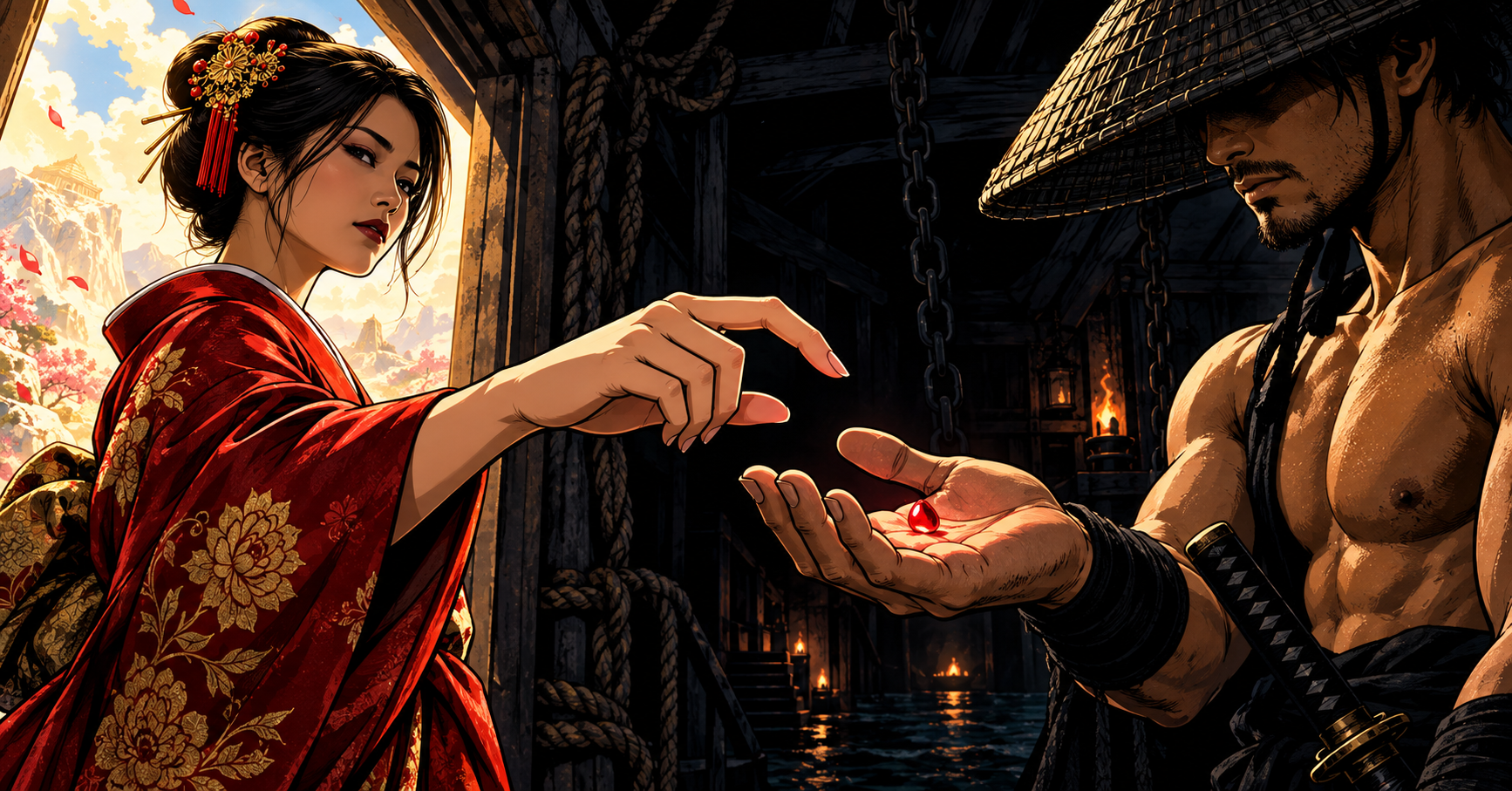
When I wrote Porcelain, the useful part of the Persephone pattern was the choice between respectable captivity and frightening freedom. Saeko lives in Governor Tadasu's yakata above Waraku, surrounded by stone walls, paper screens, and jitō who report her movements.
She has already been slipping into the lower quarter for two months to meet Seijiro. She thinks he is an arrogant man with a rented room and a door that does not lock. During the raid she learns he is the pirate captain burning her father's city.
Saeko's choice happens beside a hanging rope, far from any throne. She must decide whether to save the man who built her cage. Seijiro steps back and waits. Saeko turns her face into his chest and lets the hanging happen.
Her descent ends by going up: she boards Tielong's Daughter while the yakata burns, then chooses the open sky without any promise of a throne or respectable future.
I borrowed the myth's modern language of chosen belonging, then gave Saeko agency at the exact moment violence makes neutrality impossible.
What Saeko Thinks
Saeko lives in her father's yakata, where jitō record her movements and an arranged alliance waits. Hand her the myth of Hades and Persephone. This is what you get.
My father calls me porcelain. He says it with the satisfaction of a collector who has kept one valuable thing unbroken.
The jitō call the walls protection. They smile when they write down where I went and whose name changed my face.
Some old Greek poet wrote about a girl carried into darkness by a powerful man. My darkness rents a room above a noodle shop and leaves the door unlocked.
Then he burns the harbor. I learn what he is while his crew tears my father's order apart, and every respectable answer available to me turns to smoke.
At the rope, Seijiro waits. I can save my father with one word. I keep the word.
If a pomegranate is supposed to mark a choice, mine is a boarding ramp over open air. I walk it myself.
Paper walls, lethal sky-docks, and a pirate lover who gives Saeko the choice her father never would. Porcelain is out now on Lark Devon. Meet Saeko.
Related Questions
What is the original Greek myth of Hades and Persephone?
In the Homeric Hymn to Demeter (c. 600 BCE), Hades abducts Kore with Zeus's secret permission. Her mother Demeter causes a worldwide famine in grief, forcing Zeus to broker a deal where Persephone splits her time between the surface and the underworld.
Why is Hades and Persephone so popular in romance retellings?
Modern retellings subvert the ancient kidnapping into a story of female empowerment, turning the descent into the underworld into an escape from societal control to claim sovereignty as an equal queen.
What does the pomegranate seed symbolize in modern romance?
In ancient myth, the seed was a trick binding Persephone to the dead. In modern romance, eating the pomegranate seed represents an intentional choice by the heroine to secure her autonomy from the surface world.
What was Persephone called in ancient Greek cultic religion?
Before her descent, she was Kore ("the Maiden"). As Queen of the Underworld, Homer calls her epainē Persephoneia ("dread Persephone"), queen of the dead.
Why is Hades viewed positively in modern dark romance?
Compared with Zeus and Poseidon, Hades has few affair stories and little meddling, so retellings cast him as faithful and steady, offering the heroine an equal throne and lasting devotion.
Related Reading
- Why Do We Want the Villain? The Psychology of Morally Gray Love Interests
- The Bodyguard Problem: Proximity, Protection, and Why Guarding Someone Reads as Romance
- Why Are Vampires Sexy? They Weren't Always
Sources
- Foley, H. P. (1994). The Homeric Hymn to Demeter: Translation, Commentary, and Interpretive Essays. Princeton University Press. ISBN: 978-0691014791. Primary text: https://www.uh.edu/~cldue/texts/demeter.html.
- Homer. The Odyssey, Book 11. Translated by Emily Wilson. W. W. Norton (2018). ISBN: 978-0393089059.
- Ovid. Metamorphoses, Book 10 (Orpheus's plea; Minthe). Translated by A. D. Melville. Oxford World's Classics (1986). ISBN: 978-0199537372.
- Hesiod (c. 700 BCE). Theogony, lines 912–914. Oxford World's Classics edition translated by M. L. West (1988).
Related Posts
- The Bodyguard Problem: Proximity, Protection, and Why Guarding Someone Reads as Romance
- Fated Mates: Why Destiny Is the Genre's Most Divisive Promise
- Why Is Forbidden Love So Compelling? The Romeo and Juliet Effect Revisited
- Enemies to Lovers, According to Science
- Why Do We Want the Villain? The Psychology of Morally Gray Love Interests