Chapter 24: Home Before Dark
Chapter 24: Home Before Dark
A mark like hers rose upon him, and only death could break it after. Scarlet never went home.
— the Old Wolves' telling
“Be home by dark,” Angeau told its daughters, and for a hundred years the girls who were not had been the ones in the story.
Nobody in the valley had ever thought to say anything to the sons. The wolf at the edge of the stream had spent twenty years of third nights holding something that would not give, and he had never asked another living creature for more than a bowl left on a step. This evening he meant to ask for a great deal more. He had been rehearsing the sentence since noon, and it had not improved.
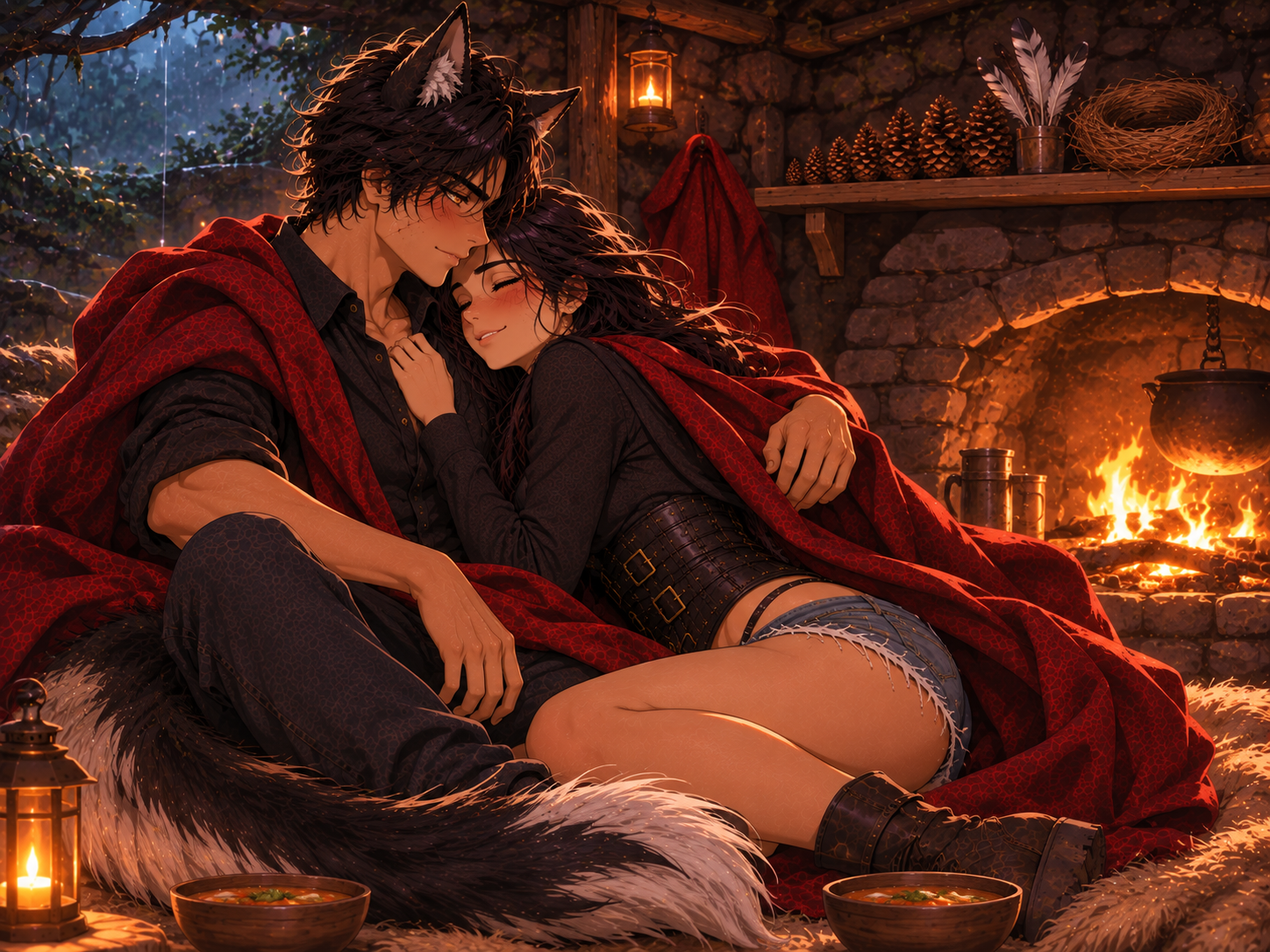
They slept through the day after the ring, in the den, with the cloak over both of them. The second night Crispin changed at moonrise outside the den and lay across its mouth while she slept against his ribs until the light came. He was awake for most of it, and it should be said that he did not mind. She used him as a pillow and a blanket, and the mark on her shoulder stayed warm all night under his hand. He would have lain there a month.
For twenty years the second night had been a tree and his own ribs. This one was a girl snoring faintly into his fur, and he did not know what to do with the difference except lie still and keep it.
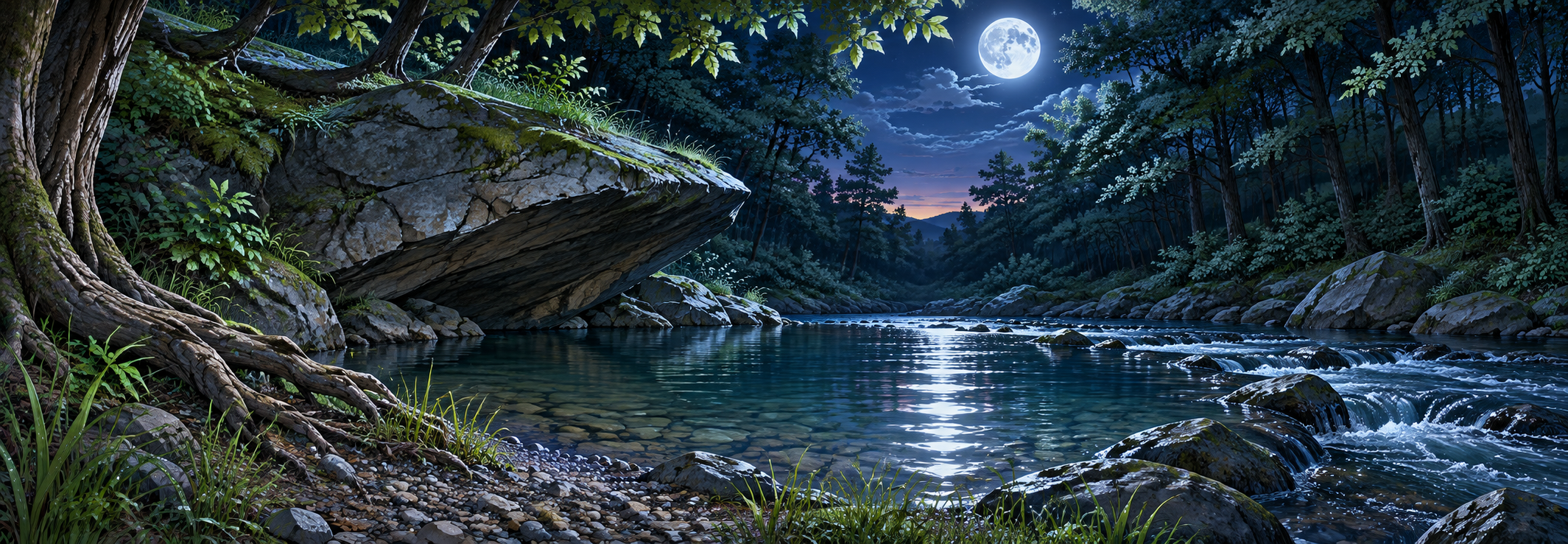
On the third afternoon his teeth began to ache at the roots, which was how he knew the last night was close. He asked her to walk down with him to the stream below the ridge, where a slab of rock leans out over a pool. He had picked the place while he lay awake. At the water he told her he had something to ask, and then he did not ask it for the better part of an hour. She sat on the bank with her boots off and her feet in the current and waited, which was a skill he envied. He paced the gravel with his tail dragging. The sun went behind the ridge and the east began to brighten toward moonrise, and he had run out of afternoon.
“Noëlle.” It came out as a statement, which surprised him. “Tonight I want you to hunt me.”
She turned around on the bank. “Hunt you.”
“On the first night you ran and I caught you. Every month before that, I ran from something and nobody came.” His ears had been pinned to his skull for the whole speech. He made them come up. “I want to run, and I want you to come after me and find me. I want to be caught. By you, on purpose, because you want to.”
She looked at him for a long time. She did not tease. Her mouth stayed serious, and the color climbed her throat. “Say the last part again.”
“I want you to come and get me.” His tail swept the gravel once, hard. “Don’t laugh at the tail.”
“I would never,” said Noëlle, and pulled her feet out of the water. “Oh, I am going to be so good at this.”
He believed her completely. It was one of the more frightening things he had ever believed.
There was one other matter, and it was mortifying. He had already torn one pair of jeans this moon, and the pair he stood in was the last he owned, so he turned his back to her, took off every stitch, and folded it on the slab. The shirt went first and the jeans after it, and he set the boots underneath, in order, because he was not capable of doing it any other way.
No story Angeau ever told had the wolf fold his trousers. The storytellers had not met this one.
“You’re folding,” said Noëlle behind him. “I’m watching a naked man fold.”
“I’m not tearing the last pair.” The back of his neck was burning, and so were the tops of his ears. His tail had curled between his legs to hide what it could and was making a bad job of it. “Don’t look.”
“I’m going to look.”
“I know.” He turned around. He stood in the open with nothing on and his hands empty while she looked at him from his ears to his feet and back again, slowly, and his tail thumped twice against the back of his knee.
“It has a lot to say about being looked at,” she said.
“It’s cold.”
It was not cold.
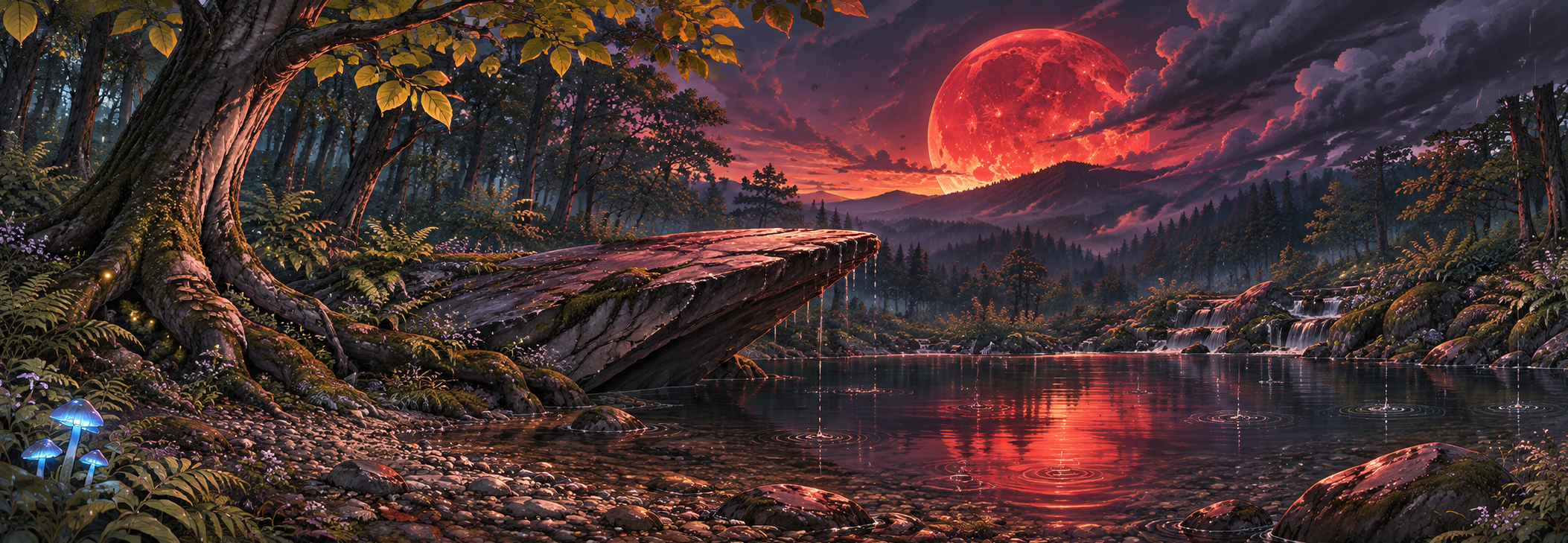
The moon came over the ridge, enormous and red, and found him with his hands open at his sides. That was the whole difficulty. Every bone in him wanted something to grip. There was a beech close by, and he did not go to it. His spine cracked down its length. The fur ran up his arms and his jaw pushed out as the claws came through the ends of his fingers into the cold air, and he stood there and let it take him with nothing in his fists. When it was done he looked down at her from a great height. She had the cloak around her shoulders and her face tipped all the way back.
“Run,” said Noëlle. “I’ll count to twenty. Twenty is generous.”
He ran.
He had never done it for the pleasure of it. The water flew up from the shallows in sheets, and he took the ridge in four strides and the dead-fall on the far side in one. He did every clever thing he knew. He crossed the creek twice and walked the length of a fallen log and doubled back through a bramble thicket that had never once got a thorn into him. Her counting carried after him, faint and far behind, and then it stopped.
After that he could not hear her at all.
All summer he had heard her heart from across the valley, her breath on the far side of the den, and which root she stepped on at the stream. Now there was nothing, and the nothing went through him like a hand down his spine. He had not known it was possible to be this thrilled by losing something.
He was honestly trying. Somewhere past the second ridge he stopped trying, and he would admit why to anyone: he wanted to be found, and a trail she could not follow would have defeated the point. He went back down to the pool, waded out to his knees, and stood in the middle of the stream with the moon on his back. His tail was swinging in slow circles over the water. He had never been so obvious in his life.
She came off the top of the leaning slab without a sound.
The girl in the old story never once came off a rock at the wolf. Nobody had thought to let her.
All of her hit his shoulders at once. Her arms locked around his throat and her legs around his chest, and he had every chance to stay upright and let his knees go instead. They went over backward together. The stream closed over his ears, and he came up on the gravel with her sitting on his chest and a wave running up both banks.
“Found you,” said Noëlle. Water streamed out of her hair into his face. She was laughing so hard that she had to hold on to his fur.
“You did.” His voice was gravel. “I did not run well.”
“You ran terribly. You left a trail a child could follow. You stood in the middle of the pool.” She took his wrists, each as thick as her forearm, and pressed them down into the gravel under the water, and put her weight on the backs of his hands. He could have lifted her and the slab together. He did not move them. “Keep them there.”
The current ran over his knuckles. All his life his hands had been busy on the third night, digging, dragging, hanging on. They lay open now, with the claws loose in the stones, and the want came up through him and had nowhere to be put.
She stood in the stream, peeled the wet top over her head, and pushed the shorts down her legs. She stepped back over him naked, with the water around her shins and the red moon on her and the mark standing out dark on her shoulder. He had never been looked down on so completely, and he was grateful for every inch of it.
“Noëlle,” he said. It was a question, once.
“Yes.” She knelt between his knees in the shallows. “All of it. I mean all of it.”
He did not ask again. She took his cock in both hands, which it required, and lowered her head, and the first touch of her tongue under the ridge of the head went through him from his ears to his heels. She could take only the end of him in her mouth, so her hands did the rest, wet and sliding, and she hummed, and he felt that in his spine. He made a sound. It was not a growl, and he would have liked to take it back. When his tail came up out of the water and came down across the stream with a crack, a wave went over her shoulders, and she came up spluttering, delighted, and put her mouth back on him without a word of complaint.
He held still. He lay in the river with his hands open and his head back, and the moon looked down at him and he did not turn away from it. She was working at him with her whole mouth now, her eyes open and fixed on his. She pulled off and wiped her lip with the back of her wrist.
“Whose are you?”
“Yours.” It came out of him at once, and firm. “All of it, Noëlle. The teeth too.”
“The teeth especially.”
She climbed up him. She turned her back to him and lowered herself onto his cock with her hand wrapped round the base and her knees on either side of his hips. He felt her take him in slowly, tight and hot, in the cold water, and the breath left him in one long shudder. She did not stop until she was seated on him to the root. She lay back along his chest with her head tucked under his jaw, and the current ran round them both.
This was what the full moon had been keeping from him: her whole weight on him and her hair in his mouth, and nothing in his hands but her.
She reached back under the water, found his right hand, drew it out, and laid it over her hip, where the old crescents were. There were four small pink moons there, healed to a rim, and she pressed his fingers into them exactly. “Here,” she said. “Again.”
He closed his claws. They went in just far enough, and she arched against him with a cry that rang off the slab. He rolled his hips up into her. The water slapped between them as he thrust again, slow, deep, until his knees were braced against the gravel and she was making a low, steady, furious sound in her throat that he would have crossed the valley for. He put his other hand on her breast. He put his mouth on her neck, on the mark, with the teeth held away, and she turned her face into his jaw.
“Touch me,” she said. “There. Please.”
He slid two fingers down between her legs, with the claws tucked back, and found her clit, hard and slick against his knuckle, and rubbed in small tight circles. She came apart on top of him. Her pussy clenched on his cock in long pulls that he felt to the root. Her heels dug into his shins, and she said his name into the sky and then said several other things. He held her down on him through every one of them. He did not let go of anything, and nothing needed him to.
He was not done. He knew it, and so did she. She laughed, breathless, still shaking, and said, “Up.”
He stood with her in his arms. She came up off his cock with a gasp and he carried her out of the stream and set her back against the leaning slab, which was wet and cold and ran with moonlight. He put his hands under her thighs and lifted. Her legs locked around his waist. He thrust into her standing, with her shoulders against the stone and all her weight in his hands, and the rock behind her was the one thing in the valley he did not need to hold on to. He had her instead.
“Look at me,” she said, with her hands in his fur. “I want you to see.”
He looked. Her eyes were black and enormous, with the moon in both of them, and her mouth was open as she looked at the worst thing that he was with nothing between them. She wanted it. He could smell it on her and feel it in every clench of her around him, and he thrust harder because she wanted that too.
“Hold still,” said Noëlle. “I want one.”
She put her teeth into his shoulder.
It hurt, and he never found a better word for it. She bit down hard on the muscle above the collarbone, hard enough to open the skin, and held on until her mouth was wet with his blood. He came undone. He drove up into her against the slab with a roar that went up the valley, and somewhere on the hill above Angeau a dog began to bark. He poured into her, hot and endless, until his knees shook. She wrapped herself tighter and rode through it with her teeth in him, and came again with a shriek against his shoulder.
“Mine,” she said, when she let go. She licked the blood off her lip. “There. It took.”
“It took,” he said.
It had taken more than his shoulder. He was still inside her, and he felt it before he saw it: her heart, which he had been hearing all night, broke into the long, heavy beat of something much bigger. Her back arched off the slab. Under his hands the skin of her thighs went hot and then rough, and white fur came up through it and ran from her knees over her hips and up her ribs, the color of the moon on the water. Her ears pushed up out of her wet hair and stood. Her eyes, when she opened them, were gold.
For one breath he was sure he had done this to her, and he was more frightened than he had been in the field.
“Noëlle.” He had stopped moving. He could not remember deciding to stop.
“I know.” Her voice dropped while he listened to it, rough at the bottom, and she was laughing in it. Her jaw lengthened against his neck. The teeth that had just been in him came down long and white, and her nails thickened into claws and closed in the fur of his back. She grew in his arms. When it stopped she was still smaller than him, but not by much, and every inch of her was moon-white and shaking and pressed against him. “Crispin. Don’t you dare stop now.”
She was laughing. Nobody had ever laughed in this form, as far as he knew, and she was doing it into his neck with her new teeth.
Nobody in Angeau had a story for this part. They would have to make one up, and they would get the color wrong.
He took her down off the slab onto the gravel. She went on her back in the shallows with the stream running through her white fur. He came down over her and drove into her again. She was hotter now, and tighter, and she pulled him in with her heels. He had spent twenty years being careful with everything in the valley that could be hurt. She showed him she was not one of those things, raking her claws down his sides and baring her new teeth up at him, and he let go of the last of the care.
He fucked her into the gravel. The stones rolled under them and the water broke over her shoulders with every thrust. She met each one, snarling up at him with her gold eyes wide open. He put his mouth on her mark through the white fur and closed his teeth on it, and she put hers on his. They held each other by the teeth and the hips, and nothing in the valley could have pulled either of them off.
She howled when she came. He had never heard her voice do that, a long, rising note that went up the valley after his roar, and the dog on the hill above Angeau stopped barking. Her body clamped on him so hard that it took him with her, and he came inside her a second time, shaking, with his forehead on hers and her claws locked in his back.
They lay on the gravel until the moon touched the ridge. He felt the change start in the fur on his arms, the long bones drawing in, and hers started with his, and they watched each other the whole way down. When it was finished he was a tired boy with a bleeding shoulder and an enormous silly grin, and she was Noëlle again with her chin on his chest, except that two white ears stood up out of her hair, a white tail lay across his knees, and the eyes looking at him were still gold. He did not ask whether it had been all right. She noticed, and told him so, and bit him again with the new teeth.
It is well known in Angeau that nothing good goes into the forest at night in the rain. Angeau, as usual, had not been asked.
Noëlle smelled the rain a day before it came. On the morning before the moon came full again she sat up in the furs, sniffed at the bramble canes over the door, and said, “Tomorrow night. All night. Big drops.” Her ears had gone forward. They did that now whenever she was pleased with herself, which was often, and she had not yet learned to stop them.
He had spent twenty years trying to teach his own ears manners. He hoped hers never learned any.
“We could stay in,” he said. He did not mean it, and she knew he did not mean it, and she laughed at him.
The moon came up behind the cloud as a pale stain, and the rain came with it. They stood in the open past the bramble gate with nothing on, her cloak on its peg in the den and the fire banked behind them, and they changed together. He had done it every month of his life, and he had never once done it beside anyone. Her bones went where his went. Her white coat came up through the rain faster than his black one, and when it was done she shook herself from her ears to the end of her tail and threw water over half the clearing and into his face.
She put her palm on the ground. He waited. The rain ran off his muzzle and drummed on the beech leaves, and under all of it he could hear her heart, slow and steady, listening.
“North of the creek,” she said. Her voice in this form came from deeper down and still had her laugh in it. “Past the birches. He’s standing up. He doesn’t like the rain any more than you do.”
“I like the rain.”
“You hate the rain. Your tail’s been down since breakfast.”
It had. He lifted it. She went first.
All summer he had walked a step ahead of her in these woods, between her and the dark. He let her go first now, and he liked the view.
It is worth being exact about the run, because he would want it later. The wood was black and loud with water, every leaf of it moving, and none of it slowed her. She went through the brambles without catching a hair. He went around them. They split at the birches without a word, she to the left along the creek and he to the right up the slope, and he knew exactly where she was the whole time, a warm pull under his breastbone that moved as she moved.
He ran as fast as his legs would go, and nothing in him pulled back. Every full moon of his life had been spent holding on: to a beech, to his own ribs, to the inside of his jaw. Tonight his hands were open and full of rain, and the wood went by under them in long black strides. There were no torches behind him and no fence ahead. He was the biggest thing in the forest, running through it as fast as he liked, and it was his to run through. He opened his mouth and let the rain in, and a sound came out of him that was not a growl or a roar, and it took him a full stride to understand that he was laughing.
The buck smelled him first. He was meant to. He swung his head and his whole rack toward Crispin’s side of the hollow and bolted the other way, straight down the creek, into her.
She came out of the rain at him white and low and fast. Crispin had watched her run since the first day of summer, and he had never seen her run like that. She took the buck at the shoulder and turned him, and he came back up the hollow toward Crispin with her on his flank, and Crispin was waiting. They brought him down together in the mud between two beeches. She had his throat. Crispin had his weight. It was over in the time it takes to say it.
They ate there, in the rain, with the water running pink off both of them. She ate with her whole body, as he had on the ridge, and growled at him once over the liver, and then pushed half of it across to him with her nose.
When they had eaten she lay down along the buck’s flank in the mud, her white fur gone gray with it, and looked up at him with her gold eyes. Her tail thumped the wet leaves twice.
He lay down beside her. The rain kept on. Somewhere south of them, a long way past the tree line, a town had its shutters closed against the weather, and neither of them turned an ear toward it.