Chapter 21: Back by Sunday

Chapter 21: Back by Sunday
They ate the buck raw under the moon. Life feeds on life, said Fenris. That is the only law that matters here.
— the Old Wolves' telling
Every house in Angeau keeps a basket by the back door, and every basket in Angeau has somewhere to be by Sunday. This is how the town keeps its promises: packed two nights ahead, tied with a cloth, and carried by somebody who would rather be carrying something else.
One basket had traveled farther than any in the town’s history and had not yet arrived. It waited behind a row of pinecones in a den the town had never found, going quietly off, and its owner had not looked at it in days. She had been very careful not to.
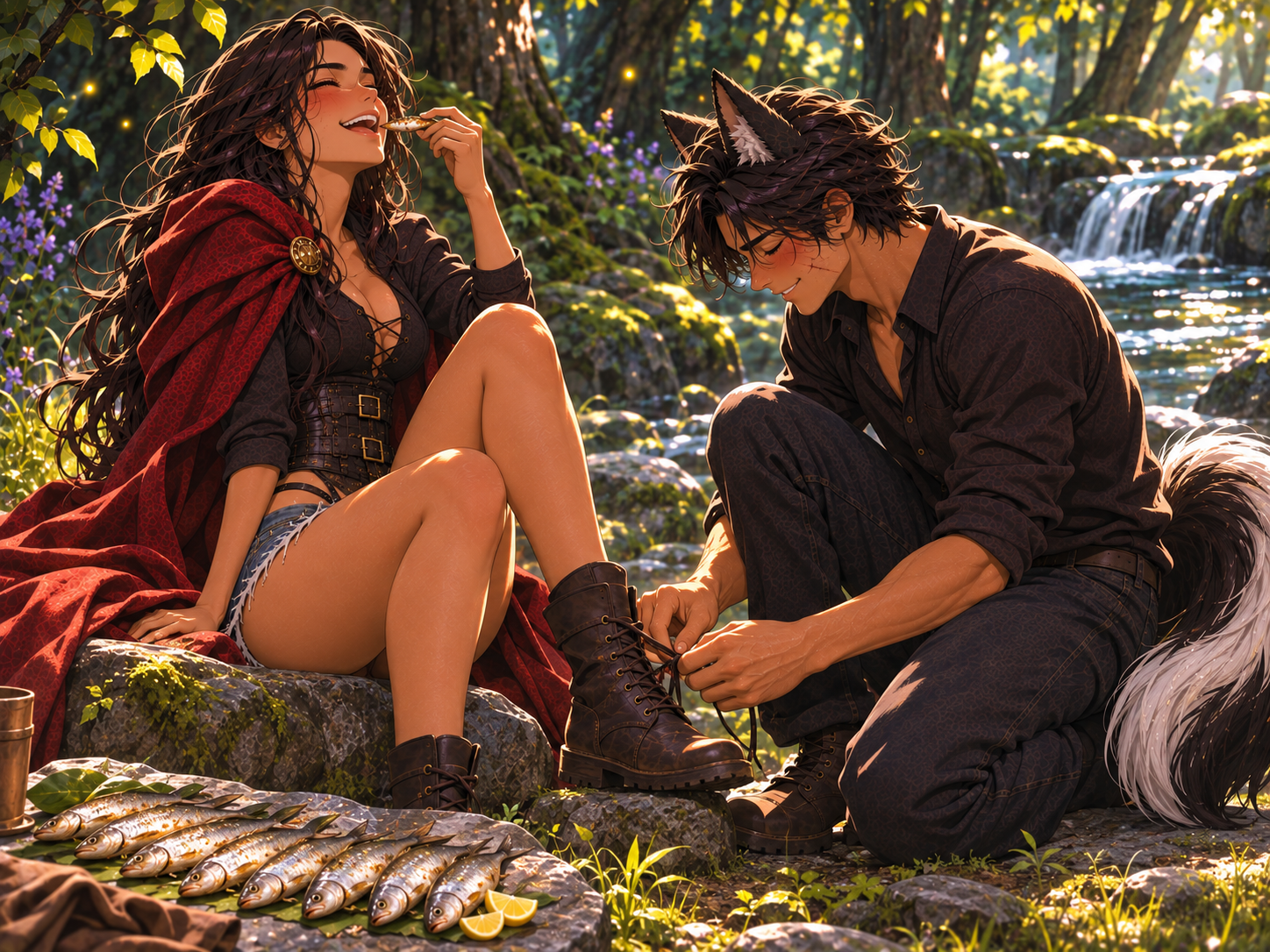
Noëlle ate nine fish. Crispin caught them with his bare hands in the stream below the den while she perched on a rock with her boots off and gave advice he ignored. He cooked them on the flat stone without burning one, which he mentioned twice. By the end she couldn’t have lifted a spoon. She lay on the furs with her feet in his lap and the whole day coming loose in her one finger at a time, and she laughed at nothing for a while. He let her.

That morning sixty people had held fire at him. Now he was proud of his fish. She thought that was the most hopeful thing she had ever seen.
His right palm had a stripe across it from the pole, shiny and angry at the heel, with pitch still ground into the edges. She had seen it in the field and said nothing, because if she had started on that she would have started on all of it. Now she sat up, took his hand, and turned it over to the fire.
“It’s fine,” said Crispin.
“It’s blistering. Hold still.”
He held still. She worked the pitch out with warm water and a pinch of sand, from the edges toward the middle, and his fingers curled once and uncurled on purpose.
Béatrice would tell the lane by supper that Noëlle had made up her mind in the field, and Béatrice would be wrong. Noëlle had looked up from Astien’s leg and seen Crispin standing at the edge of the beeches, with sixty people and every lit torch on one side of him and the trees on the other. His lip was still up off his teeth. His hand was out, black and shaking, and he stayed where he was, waiting to be told. Gaspard had held his hand out too, and Gaspard’s was a hand for collecting. She did not remember crossing the stumps. Her hand had gone ahead of her, and she had caught up with it at his wrist.
She understood it now, with the pitch coming away under her thumb. Everyone else in that field had a neighbor at their elbow, and he had stood out there by himself, with her the only person on his side of the stumps. She had seen him, all of him, alone at the edge of the trees, and every part of her had gone toward him at once. She needed to be where he was. She needed it more than she had ever needed the town to need her.
With his shirt stuck to him with pitch and stream water and the firelight lying down the whole bare side of his arm, she noticed that she had stopped cleaning and started stroking. The mark in her shoulder warmed, and the warmth did not feel like healing. She put a thin smear of Nana’s salve on his palm from the jar in her pocket and told the jar out loud that she would make Nana another. It was easier to say the next thing to his hand than to his face.
“I was meant to be back at the university by the time the leaves turned. I haven’t said that out loud since the maple. I thought if I didn’t, it might forget.”
His hand stayed in hers, but his ears dropped a finger’s width, and she watched him pick up a sentence and get ready to hand it to her. She knew which one. She had been waiting for it since the field.
“I’ll take you to the road,” said Crispin. “If you want to go, I’ll carry your bag to the road, and...”
“And walk back here by yourself and call it being good. No. That’s the speech I’m not letting you give.” She wound a clean rag around his palm and tied it harder than it needed. “It’s a silly speech, you’re very good at it, and I hate it.”
His ears came back up. “Okay. Then tell me what you want. I won’t guess it for you.”
The day before, he had guessed it for her behind a tree and built a whole plan on the guess. He had learned that fast. She did not know anybody in the city who learned anything that fast, herself included.
“I was getting to that.” She pulled her knees up. “Here is the confession, and you can’t laugh. I liked being the cupboard.”
He did not laugh. He waited, which is the thing about him.
“That’s what I couldn’t say in the field. I hated that line of people and I loved it. Josette’s cough, Jordane crying into his sleeve, Penda coming round for his knees on the days he wanted company. They needed me, and being needed was the closest I had ever come to being loved, so I took it for the real thing and said thank you.” Her face was hot, and she kept going. “A boy wanted me when I was lying on the floor of his den doing nothing at all, and I have not been able to go back to the old arrangement since. I’m not giving that up. I am also not going to become a girl who lives in a cave being adored, because I’d be bored in a week, and you’d catch me counting your shelves.”
“You counted them the first day.”
“I did. So I want both. I want to go down the hill when I choose, for the people I choose, and walk home after. I’m still a healer, and I’m good at it, and I won’t pretend otherwise to make anyone comfortable. I just don’t want to be the only one holding the door.”
“This part is mine.” He said it plainly, and she looked up, because there wasn’t a pause anywhere in it. “I walk you to the fence every time you go. I’m at the fence when you come back. If you say you don’t want to go that day, you don’t go, and I’ll tell Béatrice myself.”
That made her laugh. “I would pay to see that.”
“So would I. I’d be terrible.” His tail moved on the furs. “And the bark. Jordane is out. I know where the willows run along the north stream and which side of the trunk you want, so if you show me once, I can bring it down to the fence in the morning. So you aren’t carrying the whole forest in your own arms.” He looked at the rag on his hand. “I’d like to be useful. Not instead of you. Next to you.”
Nobody had ever offered to carry any of it. People had offered to hold the door while she did.
On the first day in the ditch he could not finish a sentence about a goblin. Now he was planning her mornings out loud, plainly, and leaving room for her to say no.
“Wardens a day behind, if Godwin’s right,” she said, when she could. “And Gaspard down there in his house with his hand still out.”
“I know. I’d rather meet them with you than without.” His ears didn’t move. “And the university?”
“Not this autumn. Ask me again in the spring.” She tried the sentence over and found she liked it. “I like that nobody is deciding it for me, including me.”
“I will ask.”
“You’re allowed to say no to anything I say, you know. You can be tired of the town. You can be afraid.”
“I’m always afraid.” He tipped his head, and the tail gave one thump. “I’m doing it anyway. That’s what I’m choosing.”
So that was decided, by two people, on a pile of furs, with fish on both of them. When she kissed him to seal it, he kissed her back with his bandaged hand held out of the way like a candle, and somewhere in the second kiss she stopped being tired.
She took hold of his shirt and pulled it up his ribs. Crispin clamped both elbows down over it.
“What are you doing?”
“Undressing you. Lift.”
“The fire is right there.” His ears were pinned flat to his skull, and the tips were red. “You can see everything.”
“That is the best thing about the fire.” She tugged. “I have been in every corner of this den with you, Crispin.”
“That was different. I was busy.”
“So be busy.” She put her palm on his stomach, over the cloth, and felt it jump under her hand. “Do you want me to stop?”
“No.” It came out instantly and firm, and he looked as appalled as she was delighted. “I don’t know where to put my arms.”
“Over your head would be lovely.”
He did not put them over his head. He turned his hip away from her instead, crossed his forearms on his chest, and his tail swung round and laid itself across his lap like a man guarding a door. She looked at the tail. She looked at him. He looked at the roof.
She had wanted a great many things in her twenty years. She had never once guessed that one of them would be a boy who stood in front of a lit torch without blinking and then hid his lap from her with his own tail.
“It’s only me,” she said.
“That’s the problem. You looked at my ribs for a full minute at the stream.”
“A minute and a half, and I’m going to look again.”
His arms came down an inch at a time. She pulled the shirt over his head and tossed it toward the fire, and he shut his eyes and let her. He was blushing pink to the collarbones over a chest ridged with old scars. She put her mouth on the longest one, low on the left side, and his breath went out of him in a rush.
“You’re staring,” he said, to the roof.
“I’m admiring. I’m a professional.”
Her own shirt went next, because it seemed fair. He opened his eyes at that, and for a while he forgot to be mortified. When she got her fingers into the top of his jeans he remembered, and the tail pulled itself tighter.
“Noëlle.”
“Tail.”
It hesitated, and slid aside by itself, slowly, outvoted, and wound around her wrist instead. He lifted his hips with his face turned into the fur. She got the jeans down his thighs and found him hard and straining against his stomach. She wrapped her hand around his cock, and the noise he made went through the whole den.
“Hello,” she said to it.
“Don’t talk to it.”
“I’ll talk to what I like.” As she kissed her way down his stomach, the mark in her shoulder burned and dragged the heat down through her, all the way to the backs of her knees, until her thighs knew about it. She took him in her mouth. He swore, which he never did, and his left hand went into her hair, and his right came up toward her face before he remembered it was wrapped.
She caught his wrist and pinned the hand to the furs, rag and all. “Not this one. It stays dry.”
“I forgot.”
“I know. I’ll remember for both of us.”
He quit covering anything after that. His ears came up and forward, then back, and his hips started to lift on their own, and he said her name, low, all in one piece. When he was shaking she let him go and wiped her mouth on her wrist. He stared at her with his mouth open.
“Your turn,” said Crispin, in a voice she had never heard him use.
There it was. She had been coaxing that voice out of him all summer with dares and legends and chains, and this time nobody had dared him at all.
He rolled them over so fast that she yelped. Kneeling between her knees, he dragged her shorts off and looked at her with the fire full on both of them and no hurry at all, and she was the one who wanted to cover up. She put her arm across her face, and he moved it aside with his good hand.
“You looked,” he said. His ears were up. Mine, she thought, and the mark flared in her shoulder. He put his mouth on her. He was clumsy at first and then he was not, because he listened to her with the same patience he gave the woods. Whatever she did with her hips, he did again, and she got both hands into his hair and said things to the roof.
“Come here,” she said, before she could finish. “Now. Inside me.”
He came up over her and pushed in slowly, with his forehead on hers and his jaw clenched, and she took all of him with her heels in the small of his back. He was hot and thick inside her. His tail had come round her thigh and was holding on. They stopped there, both breathing, and he said, “Mine,” into her neck.
“You said it in the field,” she said. “Say it again.”
“Mine.” It was firm. He pulled out and drove back in, and she felt the mark answer him in her shoulder, a hard pulse that matched his. “Mine. Noëlle. Mine.”
“Yours,” she said. “God, yours, don’t stop.”
He braced his left hand beside her head to hold the bandage clear of the furs. The tail pulled her leg higher, and the angle changed so that she cried out. She came with her nails in his back and his name in her teeth. He followed with a groan that shook the whole length of him, and his teeth closed on the mark, gently, and she came again, which was not fair, and she told him so.
Afterward he lay across her too heavy to move, with his ears flat against her cheek.
“You can look at me,” she told him.
“I am,” said Crispin. “It’s going to take a while to stop.”
She kissed him until his ears folded, and when she turned her head she could see the shelf over his shoulder. She did not look at the basket behind the pinecones. She felt it there like a loose tooth, and she held the maple leaf against her chest and fell asleep with it.
They went down to the stumps at first light, Crispin one pace behind her left shoulder with his ears out and his tail swinging, which was a decision. She could tell what it cost by how tightly he gripped the strap of his bag, which had her things in it. The field was empty at the top. At the fence Josette stood with her shawl pulled across her chest and her cough already working in it, while old Penda waited a little behind her on his stick with his bad wrist held against his coat. Astien had come up as far as the end of the fence on a stick, with his leg still in the binding she had tied in the hollow. Nobody from the bottom of the lane had come. Farther down the lane Béatrice stood in her doorway, half in, watching, and a few more faces showed in windows.
“Tomorrow,” said Josette. “It’s tomorrow.”
“It is. Unbutton the top of your dress.”
Josette glanced at Crispin. He turned his back with great politeness, then swiveled both ears the other way too, and Josette made a noise in her nose that was nearly a laugh. Noëlle laid her ear against Josette’s back. There was a wet crackle low on the right, not in the lung yet, only at the door of it. She told Josette to breathe in until she said stop and out until she said stop, and Josette did as she was told, which she had never once done at the post.
It was the same chest and the same crackle she had listened to all spring. It felt different with a wolf standing behind her with his ears turned politely away, and she could not have said why, and did not try.
“Steam over a pot of thyme every night, with a cloth over your head,” she said. “Come back to me in three days. If it isn’t better, you’re getting a poultice you’ll hate.”
“I’ll hate it either way,” said Josette, buttoning up. She looked at the stumps and then, with some effort, over Noëlle’s shoulder. “Morning,” she said.
“Morning,” said Crispin, to the sky above her head. It came out firm. His ears drifted round to face her, and he turned all the way and said it again to her face.
Penda held out his wrist without being asked. The joint was swollen and warm, an old sprain that had been left to mend by itself and had mended wrong. She bound it with comfrey she had picked at the stream that morning, and while she wound the cloth he looked at the hem of her cloak, where it trailed in the leaves. He looked a long time. He nodded once, to himself, and he said nothing at all.
She was tying off the knot when she heard someone coming up the lane who did not usually walk like that.
Her mother was alone. She wore her brown everyday dress, not the blue, with her hair pinned by someone in a hurry, and she held a cloth bundle in both hands against her ribs. She came up to the fence at a walk and stopped on the near side, with the rail between them, and she did not cross it. She had never in her life been this close to the tree line. Béatrice had told her; Noëlle could see that, from the doorway down the lane, Béatrice looking elsewhere with enormous attention.
Noëlle had spent the whole summer being angry with her mother from a comfortable distance. Up close, with the bread, it was much harder.
“Noëlle.” Mother looked her over from head to boots, the look Noëlle gave a patient, and pressed her lips together. “You’re thin.”
“I ate nine fish yesterday.”
“Eat nine more.” She held out the bundle over the rail. It was warm bread and the hard cheese from the cellar. Noëlle took it with hands that were not entirely steady. Her mother saw that, and her eyes went to Crispin, who had come to stand beside Noëlle, not behind, and had taken his hands out of his pockets so she could see them. His ears were up. His tail was out in the open air.
“You are the one with the ears,” said Mother.
“Yes, madame.”
“Do you eat?”
“Yes. I cooked her nine fish.”
“Good.” When she turned back to Noëlle the brightness went out of her face, and what was under it was tired and more like Noëlle’s own than Noëlle had ever let herself see. “Béatrice told me what happened in the field. She told it twice. The second time she left out the parts where she had started it.” She drew a breath. “I came to say something, and I’ve been practicing it down the whole lane, so let me get through it.”
“Go on.”
“There are two things in my house that I have let be one sentence since you were old enough to hold a cup. The town needs a healer. I need a daughter. When Josette said ‘your Noëlle’ I heard the town, and I answered it, and I told myself it was me. Bertrand was a way of keeping you here. I said it was a way of keeping you safe, and that was easier to say than I’m frightened.” She looked at the trees behind Noëlle. “I can’t see you out there. That is all it ever was, and I dressed it in a blue dress.”
Noëlle’s eyes stung. “Mother...”
“The town can ask you for your hands. It’s allowed to ask. You’re allowed to say no, and I should have told you so at ten years old. I can only ask for you, and I’m asking for you, and I will not be hurt if the answer is a Thursday instead of a Sunday.”
“I’m not coming back to the house,” Noëlle said. It was the hardest thing she had said in two days, even counting the torches. “Not to the east wing, not to the kitchen. I live out there now. With him.”
Her mother’s mouth worked. “And you’re well.”
“I’m very well.”
“I will learn to say that to the lane.” She almost smiled. “It will take me a while.”
“I’ll come down. I’ll come for supper, on a day I choose, and I’ll tell you which one beforehand.”
“You always chose the day,” said Mother. “You only never told me.”
Crispin spoke up then, and he did not trail off. “I’ll bring her to the fence myself. You’ll see her come out of the trees, and you’ll see her go back in. Every time.”
Her mother looked at him properly, for the first time, ears and hands and all. “See that you do,” she said. She put her palm on the top rail, which was as far as she could manage. Noëlle put hers over it, and they stood like that for a breath with the splinters between them.
“Did you ever get to Nana’s?”
“Not yet. Today.”
“Take the basket. Tell her I said hello.” She hesitated. “Tell her I’m well.”
She went back down the lane with her shoulders straight, not looking round, which was how Noëlle knew she was crying. Béatrice stepped out of her doorway and fell in beside her without a word, and the two of them went on together.
At the den she stood in front of the shelf for a long moment with her hand on the stone, and then she took the pinecones down one at a time and set them on the floor in their order, because he would have wanted them back in order. The basket was behind them, where she had left it. The cloth had gone gray. The yarrow had turned to brown threads, the comfrey had collapsed into a wet green paste, and the honey jar was empty except for a gold ring around the bottom. She carried all of it to the stream bank and tipped it out in the ferns, and she rinsed the jar and kept it.
She had been avoiding that basket since the lair, and the whole summer had gone off inside it, exactly as summers do in baskets. It was a relief to tip it out.
She could not bring Nana a basket of rot and a joke. So they picked. Crispin carried the basket along the bank and held the stems steady while she cut the yarrow at the knee and the comfrey at the base. He told her the elderflower was long past, and she said she knew, and he said he knew she knew. She laid the leaves in layers under the clean cloth. The salve jar went in on top, and the honey jar beside it, empty, so Nana could see what had eaten it. It is only fair to say it: she had never in her life been so unafraid of arriving anywhere.
“We’re going to Nana’s,” she said, and put the cloak on.
His ears jumped. They came down. He looked up the ridge toward the north and stood very still for a moment before he took his own bag off its peg and checked that the strap was sound.
“Right,” said Crispin.
“You’re coming.”
“I said I would.”
“You said any time I said.”
“You’ve said.” His tail wound once round her ankle and let go, because, she thought, he had forgotten it would. “Which way?”
His ears had jumped at Nana’s name, as they always did, and she noticed it, and she put it with the other things she had noticed and did not finish thinking. She would finish it soon enough.
“Through,” she said. “The half-day way. The one nobody takes.”
The bramble gate swung shut behind them as it always did. She settled the basket on her arm, and he took her free hand, and they went up the ridge into the early light under the trees, in the direction she had been meaning to go since the first Sunday. This time, somebody came with her.