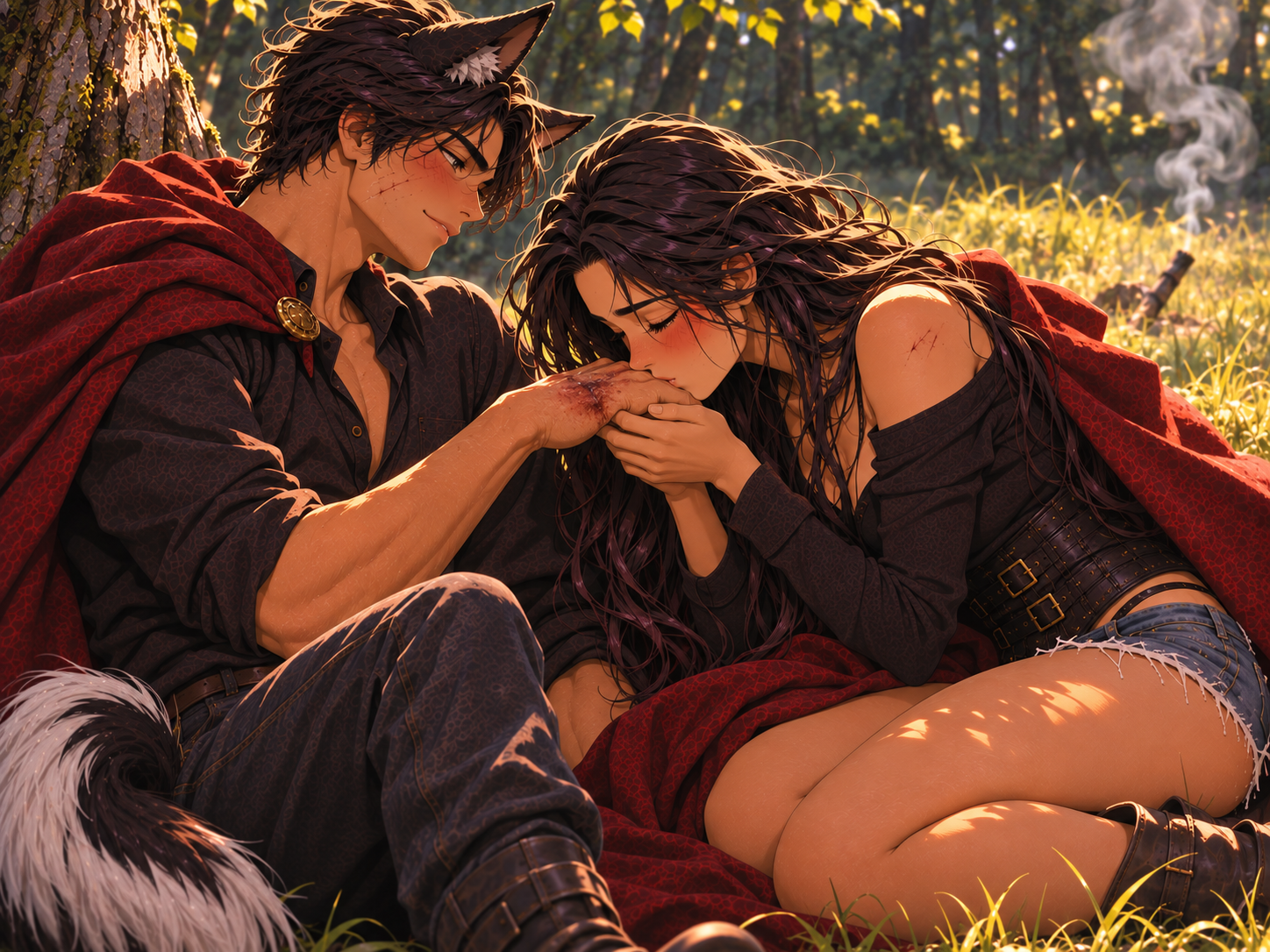
Chapter 20: Defended in Daylight
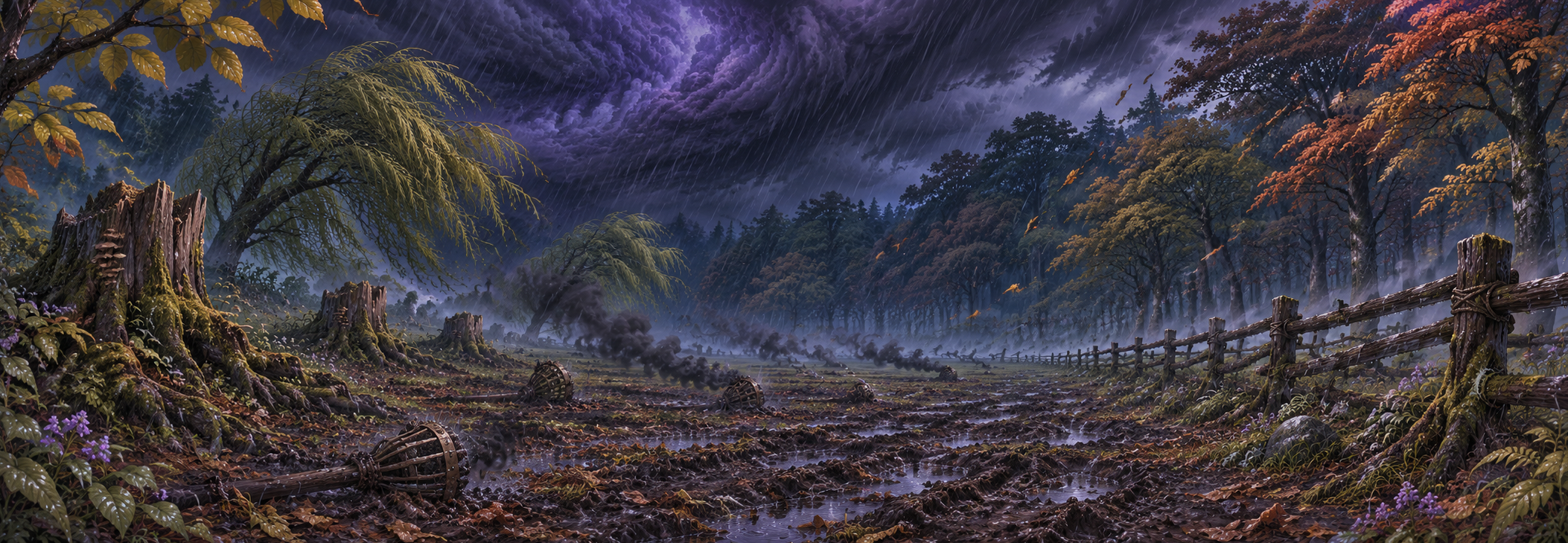
Chapter 20: Defended in Daylight
A dire bear came down on them in the deep wood. Fenris went for its throat, and Scarlet put her dagger in its eye, and it fell.
— the Old Wolves' telling
Ask anyone in Angeau about that morning at the stumps and you will be told about the storm, and about the goblins, and how many of them there were, and the number will be different every time. Ask who pulled Astien out of the willow hollow and you will be told it was a great many people. It was one, and the town has never found a way to say so without saying what it came to do.
Crispin was certain that the worst thing which could happen to him in that field was fire. He was mistaken. The worse thing was being looked at, afterward, by the people he had just pulled out of the hollow.
Nobody moved for what felt like an hour, and he spent all of it learning that a person can stand still and shake from the scalp down. Noëlle’s sleeve was against his arm. Godwin’s torch was close enough that his T-shirt had begun to warm. A thin gray line of pitch smoke ran past his cheek and up into the sun.
Nobody else in the field knew what he was holding, so it is worth setting down. It was daylight and he was in his ordinary form, so he could not have changed if he had wanted to, and he did not try. But the strength does not depend on the moon. It lives in the arms and the back and the jaw. He had spent twenty years making sure nobody in the valley ever found out, and there he was in front of sixty of them. He could feel exactly what Godwin’s pole weighed, and exactly how little it would take to put the whole thing through the nearest beech. He held still. He had learned by then that holding still and being helpless were different things, because he had practiced it with her laughing at him. A pole was lighter than anything she had asked him to hold.
What he could not hold still against was her. She stood with her hands out from her sides, palms open, in the full sun, with the cloak slipped off one shoulder far enough that he could see her collarbone and the ring of dents above it. The whole town had come to burn him, and he was looking at her collarbone. He kept his mouth shut so hard his jaw ached, and he knew without touching them that his ears were burning to the tips.
It was Astien who moved first, which surprised nobody who had watched him at the fence with his hands on the rail. He lifted the torch from beside his knee and looked at it, a man holding a thing somebody else had handed him. He crouched and drove the burning head into the dirt between the stumps, leaning on it until the pitch stopped smoking. When he stood up he had pitch on his knuckles and on his knee, and he was looking at Crispin.
“I said I didn’t know what to call you,” Astien said. His voice shook all the way through it. “At the fence. I was talking to the trees.”
“I know.” It came out level, and Crispin had not planned that. “I was behind the trunk. It’s Crispin.”
“Crispin.” Astien said it carefully, like a man trying on a coat that belonged to someone else. “I cheered, you know. In the lane. I told her that. I’m not cheering.”
Crispin’s tail, which he had been holding straight down by will since the trunk, gave one thump against the back of his knee before he could stop it. Béatrice saw. Béatrice saw everything.
“Well, that’s not the tail of a thing about to bite anybody,” she said to the woman beside her, in the voice she used for the weather. She raised her voice. “Gaspard. I told the whole lane about his ears. I told it three times and I told it well. Half the lane was at that fence when she told you no, and I left that part out, because you were the hero and it spoiled the story.”
Godwin was looking at Noëlle’s wrists. “You said it had her,” he said to Gaspard, slowly. “There’s nothing on them.” He turned his pole over and stood on the lit end with his whole boot until it hissed.
After that the torches started going out, all together, though not at once. A woman Crispin never learned the name of dragged hers along the ground until it was only a stick. Josette’s pole came down last of that row. She had her free hand against her breastbone, and she coughed into her fist and said hoarsely, “Tomorrow. You said tomorrow.”
“Tomorrow,” said Noëlle.
That left Gaspard with a pole in each hand and half a field of dead torches. Crispin watched him see it. He looked down the row and at the smoke lying in the grass, and he did not do what Crispin expected, which was to go home. He laughed.
“Look at you,” he said to the fence. “Three words from a girl who’s been living in a hole, and you’d hand her over to it.” He turned to the knot of men from the bottom of the lane who still had fire, the ones who lost sheep every winter and had never once blamed the weather. Jordane was among them, red in the face. “It doesn’t matter what she says. It’s got hold of her. She’ll thank us for it by the harvest.” He lifted his pole. “Anyone who wants his healer back, with me.”
Six of them came. Crispin counted them without meaning to. Gaspard came at the front, straight across the stumps, and he did not come wide around Noëlle this time.
The light went first.
It went out of the field all at once, from the north, a wall of cloud the color of a bruise coming over the ridge faster than any cloud had a right to. The wind came behind it. It flattened the grass on the slope and tore the pitch smoke off the torches and threw it back in the men’s faces, and it was cold, colder than the morning had been by a whole season. Under it there was a smell Crispin knew. Cold mud, and the old sweetness of fruit left too long in a cellar.
The men stopped. Gaspard stopped. Everyone on the slope looked up.
Noëlle did not look up. She turned her head toward the willow hollow, below the first beeches, with her nostrils wide. “Goblins,” she said.
He heard them a breath after she did: feet, a great many of them, and the chittering under the wind, coming up out of the hollow at a run. They were not hunting. He could hear that in them. They were running from something, and the first things in their way were sixty people from Angeau with torches.
They came out of the willows in a tide. There were more than he had ever seen in one place, more than the raiding party past the second ridge, small and gray and wild-eyed, with scraps of hide flapping and the short knives out. The first of them went into the men from the bottom of the lane before anyone had shouted. A man went down. Somebody screamed. The torches swung every way at once, and the field went from a standoff to a fight.
Crispin was moving before he decided to. He took the first goblin he reached by the belt and threw it into the two behind it, and all three went down in a heap. He caught a knife wrist in the air, turned it, and the knife dropped. He threw another into the stumps. He had done all of this before, past the second ridge, and it had been enough then. It was not enough now. For every one he threw, two more came up out of the hollow, and the wind was screaming, and somewhere behind him Josette was coughing and crying at once while Godwin dragged her back over the fence by the arm.
Gaspard was good. Crispin had not expected that, and he did not enjoy finding it out. Gaspard planted his feet in front of the men from the lane and swung the burning pole low, like a scythe, and the goblins went over in front of it in rows. He shouted the men into a line. He hauled a fallen one up by the collar and put a pole back in his hands. He was everything the town had always said he was, and he was doing it in the middle of a storm with a cut opened across his forehead and the blood running into one eye, and he did not stop.
Astien went down at the lip of the hollow with a knife in the meat of his leg. Two goblins went for him on the ground. Crispin took them both off him by the backs of their hides and threw them into the willows, and Noëlle was already there, on her knees in the mud beside Astien with both hands pressed over the wound, shouting at him to hold still. Astien was crying. She was not. Her hands were red to the wrist, and she did not look up from them.
That was where it nearly happened.
The goblin came over the stump behind her, low and fast, with its knife held point-first for the small of her back. She did not see it. She was leaning her whole weight on Astien’s leg. Crispin saw it from three strides off, and he had covered the three strides before the goblin finished its jump.
He caught it in the air by the back of the neck. He had thrown goblins into brambles all summer. He had never once kept hold. He kept hold now. The neck was thin as a branch in his hand, and he turned his wrist once, and the crack of it was loud even over the wind. The goblin went loose. He dropped it in the mud beside her, and its knife fell out of its fingers a hand’s width from her heel.
Noëlle looked down at the knife. She looked up at him.
He made the sound then, the one from the second ridge, low and enormous and coming up out of the ground. It went out across the whole slope. Every goblin left on it shrieked, high and thin, and broke, and they went streaming back down into the hollow and away along the tree line into the storm, and were gone.
The field was very quiet after that, except for the wind and the men groaning in the grass.
He was standing over a dead goblin with its blood on his hands. His lip was still up off his teeth. He could feel it there, and he could not make it come down. He looked up, and sixty people were looking at him.
None of them had ever seen him do that. He saw it go across their faces one by one, wind through a field of grass, and he saw what it left behind. The man he had pulled two goblins off was staring at him from the mud with his mouth open. The women at the fence had their hands over their mouths. The men from the bottom of the lane, the ones he had kept alive, were backing away from him with their poles up.
“You see?” Gaspard said. He was breathing hard, with the blood running down into his eye, and his voice carried over the whole slope. “You see it now? That’s what it is. That’s what she’s been living with.”
He swung the pole.
Crispin put up his right hand and took the shaft out of the air a forearm below the flame. It stopped dead in his fist. The heat came across his knuckles and into his palm, and he smelled his own skin, and the pitch smell, and nothing else. Gaspard pulled. He put his back into it until his boots tore up the leaf mould, but the pole did not come. Crispin felt the lean waiting in his arm, the push that would have put the burning head back into Gaspard’s face, ready and pleased with itself. He knew whose idea it was: his own. It went back down. He took the head toward the ground and set the flame into the mud and leaned on the shaft until it smothered, and when it was out he opened his hand. The palm was black with pitch, and under the pitch it was already blistering.
“I’m sorry,” he said. “About the pole.”
Nobody laughed. The torches that were still lit had swung back toward him, every one, as they had come up the lane that morning. The men from the bottom of the lane had closed up behind Gaspard. Jordane had his pole leveled at Crispin’s chest. Even Godwin, on the far side of the fence, had picked his up again.
He had pulled a man out of the hollow. He had broken a goblin’s neck for them. He had stood still in front of their fire all morning. None of it had moved them as far as one sight of his teeth had moved them back.
The first drops of rain came then, large and cold, and he understood he had to go.
He did not run. He took three steps backward, toward the trees, and stopped at the edge of the first beeches, where the shadow began. His hand was screaming. He held it out anyway, open, palm up, black and blistered and shaking, toward the girl kneeling in the mud.
He had asked her for a great many things that summer. This was the only one he could not bear to hear no to. He asked it anyway, with his hand out and his mouth shut, because asking was the one thing he had that Fenris never had.
Noëlle got to her feet. Astien’s leg was bound. Her hands were red with his blood and the rain was starting to wash it off them in pink lines.
Gaspard was closer. He was between her and the fence, a big man with blood in his eye and the whole town behind him, and he held his hand out to her too, the clean one, held out for something he had already paid for. “Noëlle,” he said. “Come here. Now. It’s over.”
The rain came down harder. Crispin could not hear her heart over it, for the first time all summer, and he did not know. He stood at the edge of the trees with his hand out and did not know, and it was the longest he had ever stood anywhere.
She looked at Gaspard’s hand. She looked at Crispin’s.
She walked past Gaspard without a word. She came across the stumps through the rain and took Crispin’s hand, the burned one, and as she took it she turned her grip without looking, so that her fingers closed around his wrist above the burn and not on it. That was all she said about it.
They ran.
He looked back once, at the first bend under the beeches. The rain had come down hard over the slope, and the last torches were going out in it, hissing. Gaspard stood alone in the open ground between the stumps, where she had left him, with the town at the fence behind him. His hand was still out. It closed, slowly, on nothing.
Crispin did not look back again.
They went up the ridge with the storm on their backs and the trees roaring overhead, and the rain ran in through the canopy in streams. She kept her hand on his wrist the whole way, above the burn. She did not let go at the stream, or at the ridge, or at the bramble gate, which swung shut behind them as it always did.
She had not said one word since the hollow. She had not let go, either, and he understood that she was not going to.