Chapter 19: The Cupboard Closes

Chapter 19: The Cupboard Closes
They ran the night through, and she felt the old magic of the ground come up through her bare feet. The forest has claimed thee, said the Wolf, as I have.
— the Old Wolves' telling
When Angeau went to put out a fire, it went all together, and when it went to start one it went all together as well, which is why nobody could ever say afterward whose idea it had been. The town arrived places in a crowd and left them in ones and twos, each of them certain they had only come along to keep the others from doing something foolish.
Noëlle knew this about her neighbors better than anyone, because she had spent twenty years being the one they came to afterward. She had never once tried standing in front of them beforehand.
She woke before he did, which almost never happened, with his arm across her ribs and his face in her hair and the mark warm as a stone left out in the sun. For a few breaths she lay there and let herself have the other choice. It is only fair to report it, since worse has been reported. The post sounded wonderful. She would stand with her head down handing out poultices, Josette would call her a treasure, and nobody would ask where she had spent the summer. Her hands wanted it most. They knew how to be that girl without her.
He was bare to the waist, and so was she, and everywhere they touched was warm. His forearm lay across her ribs with the dark hair on it and his long fingers curled against her stomach, and she remembered where those fingers had been a few hours ago. She wanted, with half the town and a field of pitch outside, to roll over and do it again.
She was aware that this was not what a sensible woman thought about on the morning of a burning. She had stopped expecting much from herself on that front around the time of the springs.
His ears came up against her cheek, and he was awake.
“It’s morning,” said Crispin, into her hair.
“I noticed.”
“You said to ask.”
“I did say that.” She rolled over to look at him. He had not slept, by the dark smudges under his eyes. His tail lay across the furs and did not move. He was holding it still on purpose so it could not give him away. She loved him a little extra for that: a boy who had learned to hide his own tail from her and was still so bad at it. “Go on, then.”
He swallowed. “What do you want to do?”
Nobody in Angeau had ever asked her that on a morning that mattered. They asked what she could do, and how soon.
“That’s a terrible question. I’ll answer it anyway.” She sat up and found her boots, because a big thing was easier to say with her hands busy on the laces. “I’m going to the stumps. I’m going first, and I’m going in the cloak, and you’re going to wait at the last big trunk until I say your name. Then you come and stand beside me. Not behind. Not in front, either, because I can’t have you in front.”
“Beside,” he said.
“And not east.”
“Not east.” His ears went back, and came up again by themselves. “I’m... I wasn’t going to ask you to change it. I was going to say I’m coming.”
“I know. I only wanted to hear you say it with your mouth.”
What she had worked out by then was not noble, and there is no use pretending it was. She was furious. She had lain awake half the night turning it over. Underneath the love and the fear there was a hard little pebble of temper, and she trusted the pebble. Her whole life the town had come to her when it bled, and she had never once asked for anything back. That morning she was going to, and she wanted to see their faces when she did.
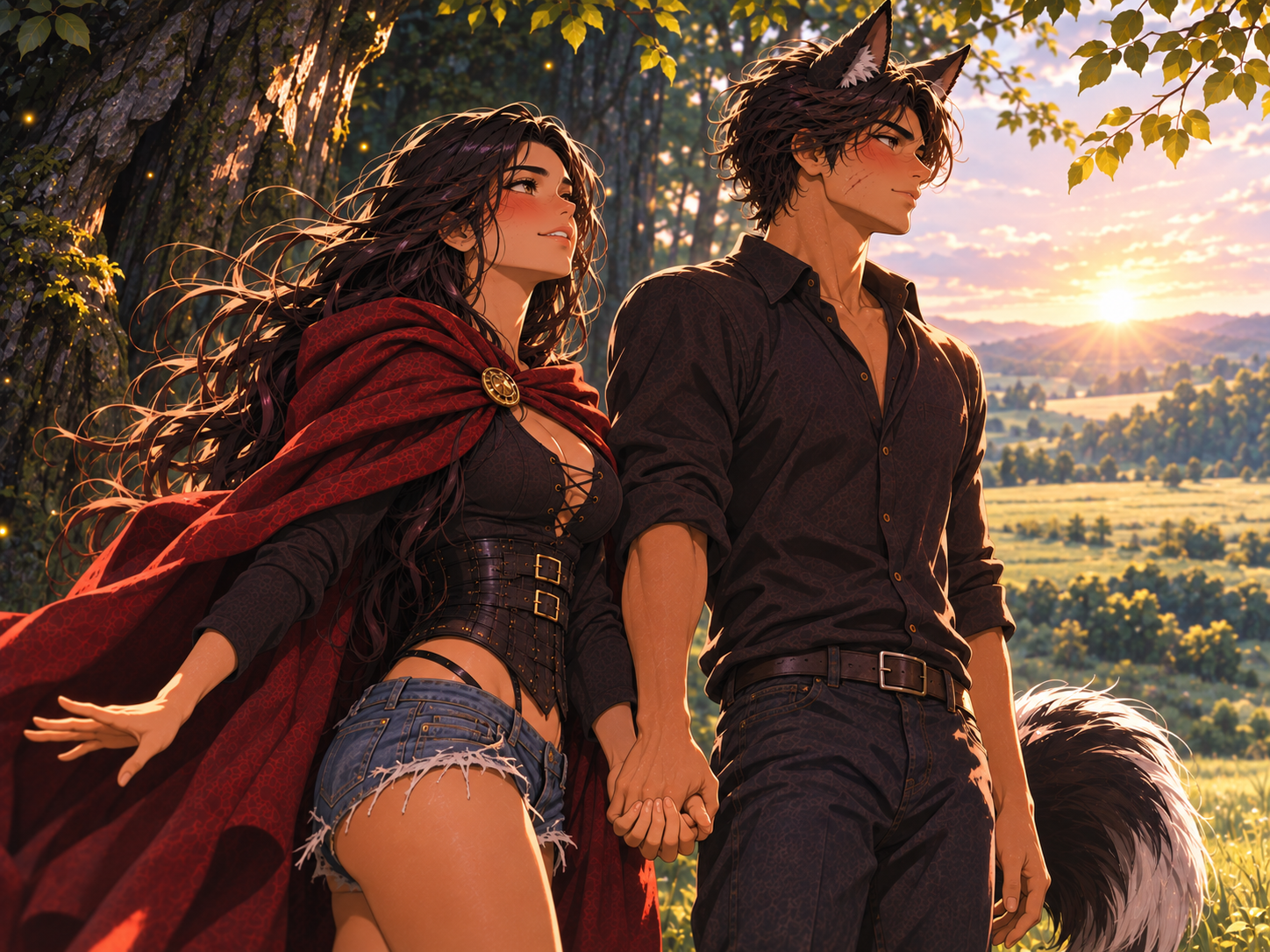
She left the knife on the shelf. He found his T-shirt under the furs and pulled it on, and she watched the scars disappear with real regret. After she tied her hair back with the string from her pocket and washed her face in the stream, she put the cloak on over her cropped top and her torn shorts, which her mother would have had something to say about, and pushed the hood back so that every bit of red showed. She took nothing in her hands, and she wanted them to see that. Her hands were the only thing she was bringing.
They heard the town a long way off. Somebody was leading a song, a harvest tune about a good crop and a full barn, and it was so far out of key that she would have laughed if she had been anyone else. A wolf doesn’t like a loud crowd. Gaspard had said so. He was right about that much.
When she stopped at the last thick trunk, Crispin stopped behind her, and she turned around and put her palm on his chest. It was going like a rabbit’s. She left her hand there longer than she needed to, on the heat of him through the thin cotton, and when her thumb found his collarbone his breath caught and his ears dropped.
“Wait for me to say it,” she said.
“I’ll wait.” His hand closed over hers and then let go, and he did the hard thing, which was to stay where he was while she walked away from him. The mark went cold in her shoulder as she came near the line and stayed that way, a thin ache like the bone remembering a break. She let it.
Every bit of him wanted to follow her. She could feel that in the cold, and he stayed anyway, because she had asked. She had spent the summer teaching him to want things out loud, and it turned out the harder lesson was this one.
The field was empty. They had come up the lane already and were standing at the fence in a long crooked row with the sun in their faces. When she came out of the thick trees they stopped singing all at once. The torches were lit, in broad daylight, with the flames pale and thin and the pitch smoke lying along the grass. Gaspard stood in front with a pole in each fist and his jaw set, and when he saw her his whole face lit up.
She had known that face in the lane since she was small. It had never before been pointed at her with a torch behind it.
She did not go to him. She walked only as far as the first beeches, where the ground rises above the willow hollow and the trunks stand wide enough apart for a crowd to see through, and she stopped in the open ground between them, in the sun, in the red cloak. She was the brightest thing on the whole slope.
She looked for her mother’s face first. Her mother was not there, and Noëlle could not have said which way she wanted it.
They came toward her across the stumps, a bit at a time, as a crowd does when nobody wants to be the first over the fence, and then all at once they were on the near side of it with their torches up and their boots in the leaves. The woods did not like it. She could feel that through her soles. Béatrice had her shawl pulled over her mouth. Astien had a torch in both hands, held out at arm’s length, as far from his body as it would go. Old Penda stood near the front, bent over his bad wrist where he held it against his chest, not looking at the torches or at her. He was looking at the cloak, a little too long, and he did not say what he was thinking.
“Noëlle.” Gaspard let out a breath and gave her the smile he used in the lane. “Thank God. Are you hurt? Is he close? Come back behind the line, love, and we’ll do the rest.”
“I’m not hurt, and I’m not going behind anything.”
“You’re not yourself.”
“I’ve never been more myself in my life, Gaspard. It’s been a bit of a shock for everyone.” The joke arrived a half second early, and she let it, because her knees had begun to go and she needed something to hold her up. “Where are the wardens?”
Godwin answered, because Gaspard didn’t. He was close behind with a pole over his shoulder, a big man, loud and red in the face, and it came out of him in a grumble. “A day behind, maybe. We weren’t going to stand about for them.”
“So you gave up waiting.”
“We gave up letting you sit out here with it,” said Gaspard, and the town murmured agreement behind him, a low steady noise that she knew very well from mornings at the fence post. “Nobody blames you, Noëlle. That’s what I’ve been telling them for weeks. A thing like that gets hold of a girl. It’s not her fault. We’re going to take you home, and the wardens will see to the rest in their own time, and nobody will say a word about it afterward. I promise you that.”
A thing like that. He had never once looked at Crispin long enough to see a face, and he had been telling the whole lane what the face meant.
“You promised me something else,” she said.
He blinked.
“At the fence. You said if I walked out alone in front of everyone, you’d take me home and say no more.” She spread her arms, and the cloak fell open on either side of her. “I’m out. Look. That’s everyone. I don’t see a single person missing.”
For a moment he honestly did not seem to follow. He did in the end. His face went through a few expressions, and the one it stopped on was the one he used on his own mother.
“That was meant to bring you home, Noëlle.”
“It was meant for me to walk out. I walked out.” Her voice was steadier than her knees. “So say no more. You’re good at keeping your word, everybody says so. Say no more, and put the fire down, and go home.”
“I can’t do that. There’s a beast in there, and I won’t leave it for the next girl.”
Behind her, on the slope, a twig broke under a boot that was careful about where it went. She did not turn around. She said his name instead, once, not loudly, in the voice she used on a patient who has been brave for as long as he can manage and is about to be brave a bit longer.
“Crispin.”
She thought about that walk many times afterward, and she never did work out how he managed it.
He came out from behind the beech with his hands open at his sides and his shoulders level, in a T-shirt and old jeans worn through at the knees, with his ears standing straight up in the sun and his tail hanging down behind him. She could see the whole town see it. She saw him as they did, and as she never had in daylight: tall, the T-shirt snug across his chest, the sun on his bare forearms and his jeans low on his hips, and she knew exactly what was under them. Two girls by the fence looked once and kept looking, and she felt a hot, ridiculous satisfaction that he was hers, until she remembered the pitch. The song would not have started again for any money. A woman near the back made a small sound and put her hand to her mouth. A torch dipped and came up again as he stopped beside her, close enough that their sleeves touched. He did not stand in front of her. The mark warmed all the way down her back and lower, which was entirely inappropriate for the occasion, and she let it.
He had spent his whole life hiding from exactly these people. He had walked out into all of them because she said his name once, and he had stopped where she asked him to.
“There,” she said, to all of them. “That’s who you came to burn. Have a good look. It’s a lovely morning for it.”
Nobody laughed. She hadn’t thought they would.
“Step away from her,” said Godwin, and the pole came down off his shoulder. He came on in heavy steps and stopped with the flaming head of it an arm’s length from Crispin’s chest, where the heat of it shivered the air. Crispin did not step back, though it cost him. His tail did not thump, and it did not drop. It hung straight down and stayed there while he kept his eyes on Godwin’s face and his hands open. She knew what each of those things took out of him, because she had spent a summer learning to read him.
“I’m not going to run,” he said. His voice was low and plain, and he finished every sentence. “And I’m not going to hurt anyone. I haven’t, and I won’t. You can look at me as long as you want.”
Every sentence finished. She had never heard him manage three in a row. He had saved them, apparently, for a man holding fire at his chest.
“Hear that?” Gaspard said, loudly, to the crowd. “That’s how they talk. It’s all very sweet until the moon is right.”
“The moon isn’t right,” she said. “At the last full one I was there, and he held on to a beech all night with his claws in his own ribs so that nobody in Angeau would wake up bleeding. That’s what he spent that night on. Nobody here has done a quarter as much for you.” She turned her head. “Josette.”
Josette was near the middle with a pole propped in the crook of her arm, and a cough, a little wet one, was working itself up her chest while Noëlle watched her fight it down.
“That’s in your chest, you know. It’s been in there since the spring, and it’ll be worse by the first frost, and you’ve been asking me about it at the fence for a month. Who do you think is going to listen to it properly this winter? You? Jordane.” He flinched, a big sunburned man with a pole in his hands. “Tobias had two hot nights and you didn’t send for anyone else, because there isn’t anyone else. You’re out of willow bark. Where do you think the next bark comes from? It comes from a tree in these woods, and I know which one, and I’m the only person in Angeau who does.”
“Noëlle,” said Béatrice, behind her shawl. “Nobody means—”
“Béatrice, you tore rags for this. Every burn in your house has come to me. Penda, your wrist isn’t right, and it won’t get right by itself. Astien, I cleaned the cut on the hand you’re holding that torch with, and you cried a bit, and I never told a soul.”
“That’s true,” Astien said, to the ground. “She didn’t.”
She took a breath. Her hands were shaking, so she turned them over where everybody could see them, palms up, and left them there.
“Here is how this goes. I am Angeau’s healer. I don’t have a cleric or a second pair of hands or a school behind me, and none of you will find another one by Thursday. I have been your cupboard for as long as I’ve been tall enough to reach the shelf, and I never minded as much as I should have. But I will not heal a town that walks into the forest with fire to kill him. I won’t do it for any of you. If those torches go one step farther, I take my hands and I go, and the next time your child is hot in the night, you can carry him to the wardens and see how many of them know what a cough is. If you put it down, I’ll come in tomorrow and do Josette’s chest and Penda’s wrist, and I won’t say a word to anyone about this morning. That’s the whole offer. I’m not going to ask twice.”
It was the first time in twenty years she had told Angeau no. It felt less like courage than like being sick behind a hedge: ugly, necessary, and an enormous relief once it was out.
It was very still after that. A torch hissed. A drop of pitch fell off one of the poles and lit on the leaves, and Astien stamped it out without seeming to know that he did.
“That isn’t you,” Gaspard said finally. He had come a step closer, and he pitched his voice to carry, reasonable and wounded, the voice he used when he wanted a room on his side. “Noëlle, listen to yourself. You’d leave the sick to die over a boy? Over a creature? Look what it’s done. A girl who has cared for every one of us her whole life, standing here threatening children.”
It landed. She had known it would; he had found the one place in her that still flinched. For a breath she was a small girl again, sitting up with somebody’s fever because nobody else would.
“I haven’t touched a single child.”
“You’re threatening to.”
“I’m threatening to stop,” she said, “and that is different, and you know it is, because the day I stop, you’ll notice. You never noticed once while I was doing it.” Her voice had cracked on the last word. She was angry about that, and she kept going. “He hasn’t made me do anything. I asked him. I asked him for all of it. If somebody had to be chased, it was me doing the chasing.”
Somebody at the back let out a startled breath that was nearly a laugh. Béatrice’s shawl had slid down off her mouth. She was looking at the two of them with her sharp eyes, and for once she did not seem to be deciding what it meant.
“The Order’s law says an unregistered wolf—” Gaspard began.
“The Order isn’t here. You are.” She looked past him at the stumps. “Neither is anyone else, Godwin, and you can check the road. If the wardens are only a day behind, then wait the day. He’ll be exactly where he is.”
Godwin looked. She would give him that. He turned his big red face over his shoulder to the long empty slope behind the fence, where the lane ran away to the road, and she watched him find nothing on it. When he turned back, his pole had dropped by a hand’s width, and he did not seem to have noticed that either.
“A day is a day,” Gaspard said, to him, to all of them. He sounded hoarse. “Hold the line. Hold it. It’s one boy.”
Nobody stepped forward. Nobody stepped back. Josette had her pole pointed at the ground and her free hand pressed against her breastbone, and Jordane’s head was turned to the side, listening, she thought, for a child at home. Astien’s torch was still lit, though he held it low by his knee now, pointing at his boots. Pitch ran down the shaft onto his knuckles, and he did not wipe it off. Crispin’s sleeve was against hers. His arm was shaking, and so was hers, and neither of them said so.
She kept her hands out, palms up, in the sun.