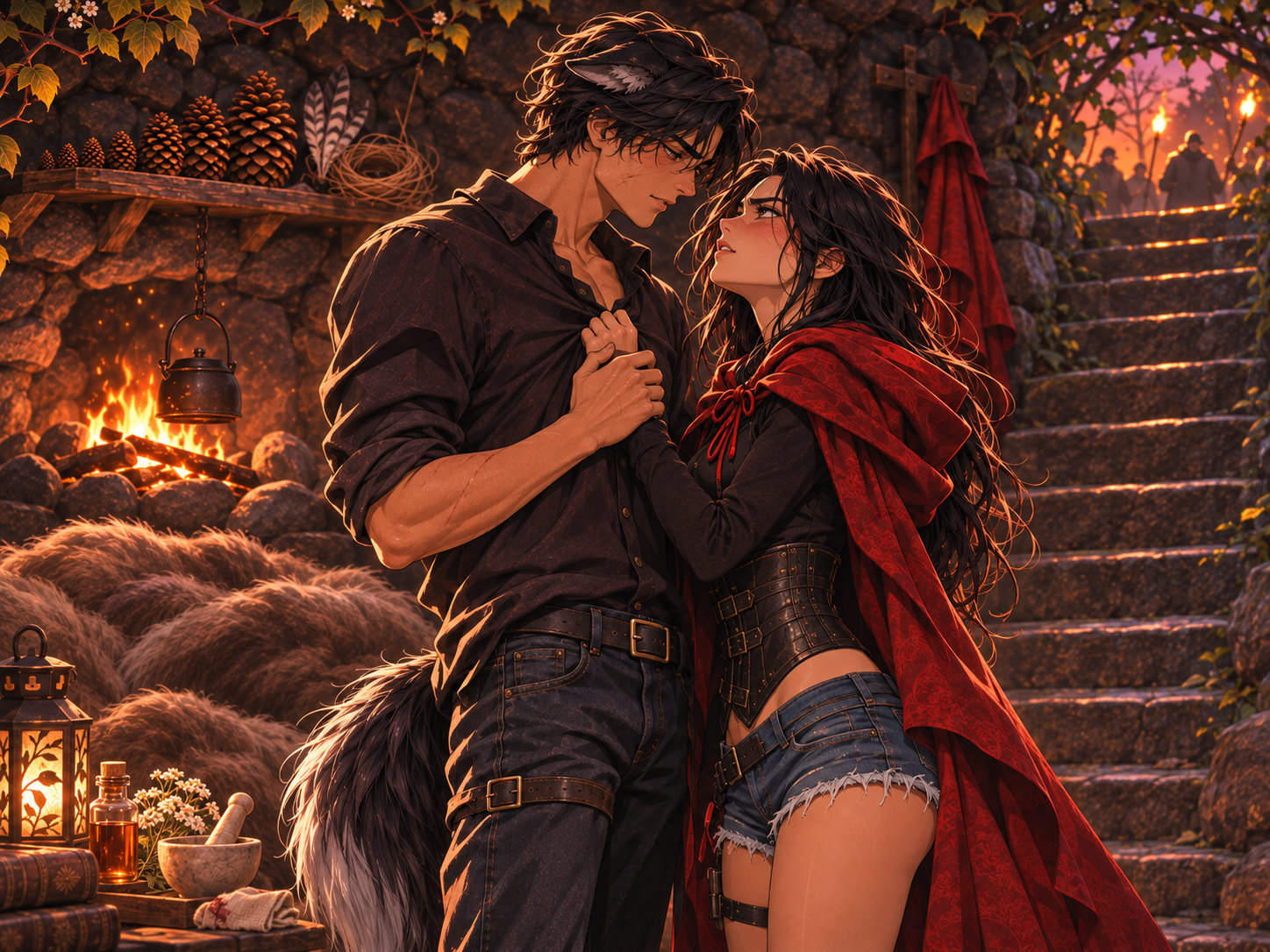
Chapter 18: The One Good Thing
Chapter 18: The One Good Thing
I will not take thee until the mark allows it, said Fenris. He had never in his life asked leave of anything.
— the Old Wolves' telling
The hunted wolf in every Angeau story ran, and the storytellers, who had never been hunted themselves, agreed that he ran a very long way. None of them asked where he thought he was going, or who would be left holding the torches when he got there.
Crispin had never heard those stories at a fire. He had picked them up in pieces from the far side of a fence, which is the worst place to hear how a story ends, and he had decided that running was the one useful thing a creature like him had left to do.
They walked home through the gray end of the night with the cloak over both their shoulders, and neither of them said a word about what had gone by them in the trees. By the time the light came it was only wool again, and it kept the damp off. He didn’t look at it any harder than that.
He did not trust himself to. He had watched the cold stop at the hem of that wool, and he had a guess about whose hands had made it, and the guess was not his to say.
Noëlle fell asleep in the nest before the sun reached the den, with her boots still on and one hand shut around his sleeve. He worked the sleeve out of her fingers a thread at a time. He would have liked to say he did it for her sake. He did it because he knew that if he lay down beside her he would never get up again, and somebody had to go and find out what the file was for.
She would know. The mark on her shoulder went cold when he got as far as the line. He went anyway. He was counting on her to sleep through it, and that was the first thing to hold against him that day.
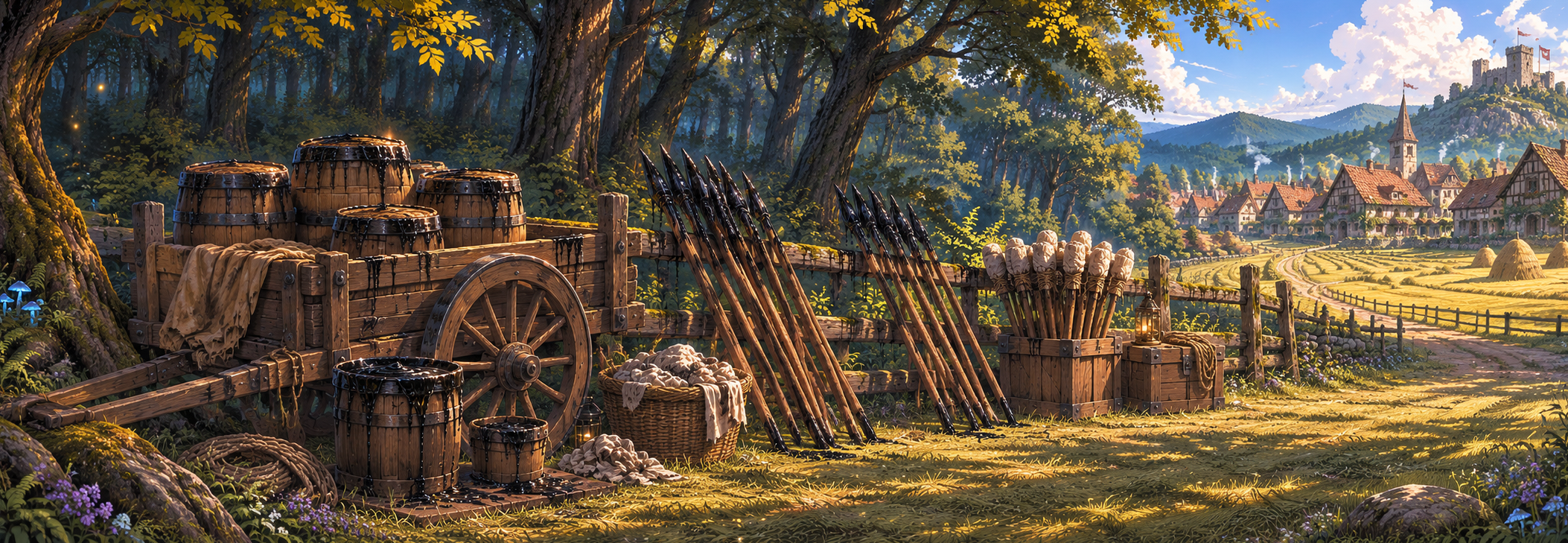
By the time he reached the last thick trunk the sun was high and the field below the fence was full of people. A cart of pitch barrels stood at the top of the lane. Men were dipping the heads of long poles into one and leaning them against the rails in rows to drip. The smell of it came up the slope so thick that he breathed through his mouth. Béatrice was walking along the fence with a basket of rags on her arm, tearing them into strips. Astien stood at the end of the row holding a pole away from his body, and he did not look at the trees once.
A few mornings ago Astien had stood at that same rail and talked to the trees. Today he would not look at them, and Crispin could not blame him for it, and wished he could.
He put his back against the bark. His ears had been turned toward the field since the ridge, and they brought him Gaspard before he could see him, because Gaspard was walking the line and talking as he went.
“At first light. Everyone together as far as the stumps, and no one goes ahead of the line. We keep it tight, we keep the torches up, and we go in singing if we have to. A wolf doesn’t like a loud crowd.”
That was true, as it happened. Crispin did not like a loud crowd. He did not like a quiet one either, and he had never stood close enough to either to find out which was worse.
“The wardens could be a day behind us,” Godwin said. He was close to the cart and had said it several times already.
“They could be a month behind us. Is she sleeping better because they could?” Gaspard waited. When nobody answered him, a pole scraped against a rail. “She’s been out there with it for two moons, Godwin. Two. I will not stand at this fence for a third and tell Jordane she’s still somewhere in those trees because we wanted the proper paperwork.”
After a long silence, Godwin picked up a pole of his own.
When Gaspard climbed onto the tail of the pitch cart, where the whole field could see him, the whole field turned to look. He was good at being looked at. He had the shoulders for it and the jaw, and the sun was on his hair, and he knew it.
“Two moons,” he said. He did not shout. He did not need to. “Two moons that thing has had our healer. Jordane, who sits up with your boy when he’s hot in the night? Penda, who sees to your knees? And where is she now? In a hole in the ground with a wolf, because nobody in this town had the stomach to go and get her.” He let that sit. “I have the stomach. I’m going at first light, if I go alone.” He lifted his pole so the pitch on its head caught the light. “I would rather not go alone.”
Jordane shouted first. He lifted his pole over his head, and the shout went down the fence from man to man until the ones at the far end were shouting without having heard what for. It was not a large sound. It was all of them, and Crispin felt it in his teeth.
They made torches after that faster, and they made them singing. The people doing it were not cruel. Béatrice kept stopping to push her hair back with her wrist. A woman he didn’t know had brought bread and was breaking it for the men with pitch on their hands. These were the same hands that had been glad of Noëlle’s willow bark. They were tired and frightened, and a man on a cart had given them somewhere to put it at last, and a tune to put it to.
It is worth being exact about what he felt. All his life he had known what he was for in that valley: he was what mothers named so their children would come in at dusk. Noëlle had talked him out of believing it for two months, one joke and one bandaged hand at a time, but standing there, with the town at the edge of the field, it came back in a single breath. There was a lane of torches because of what stood behind this tree. Everything he had ever done carefully, every window survived and every beech he had held onto, had only delayed the day it was shown.
A few mornings ago he had walked these woods like their owner. A row of poles drying against a fence took that back without anybody raising a voice.
He thought of the seep. He had stood in the mud with his whole body shaking while something went by that made the trunks leave and come back, and he had done nothing. He could fight a goblin. He could not fight that. A girl in a red cloak had pulled him down into the roots, where the cold had stopped at the edge of the wool. He had been the one with the claws, the long arms and the strength, and she had been the one who kept them alive. Whatever was coming down that field at first light, he would stand against it exactly as useless as he had stood against the thing in the north woods, and she would put herself in front of it again.
He could not stand that. Torches he could stand. He had expected torches his whole life.
He knew what to do about torches. Gaspard wanted a wolf to put down, and the only thing he wanted back was her. If the wolf went east along the stumps tonight, where the field could see him, and kept going, then every torch in that row would turn after him. She would have a hero standing in an empty field and a town that wanted its healer home. Josette would get a chest to listen to. Penda would get a wrist looked at. All of it came out of one afternoon of being gone. It was the first time in his life that being what he was could be turned into something she could use.
It felt very much like a gift. He was too pleased with it to notice that he had made it without asking her, which was the one thing she had never once done to him.
His tail was hanging straight down against his leg. He let it. As Astien lifted the pole in his hands and set it back against the rail, Crispin took his hand off the bark and went back up the ridge without making a sound.
She was awake when he got in, sitting cross-legged by the fire with a bowl in her lap and a second bowl waiting on the stone beside her. She did not ask where he had been. Her shoulder was bare, and she had her palm over the mark, holding it there as someone holds a hand near a lamp to find out if the lamp is still lit. The strap of her top had slipped down her arm so the firelight lay along her collarbone and the curve under it. He looked for much longer than he had any right to, until his ears were burning and he made himself find the wall.
The wall was no help. He had come back up the ridge to say goodbye to her, and the first thing his body wanted, on seeing her, was the opposite of goodbye. It had never once consulted him about anything, and it was not going to start tonight.
He had practiced all the way back. The version in his head was seven sentences long and had no ellipses in it.
“Noëlle. I need to say something, and I need you to let me get to the end.”
“That’s the second time this week.” She picked up the other bowl and held it out, and he took it and couldn’t eat it. “Go on.”
“It’s... a good thing. I think. It’s the one good thing I... that I have to give.” His ears were already going down. “I’m going to leave tonight.”
She did not move.
“East, along the line, where they’ll see. Gaspard wants me, and not... not you. He’s said so. If they follow me then you’re here, and in the morning you walk down the field, and he said he’d take you home and say no more about it. Your mother would... and Josette’s chest, and Tobias, and Penda’s wrist, and you’d be...” He had lost the seventh sentence somewhere in the fifth. “You’d be able to be useful again. You wouldn’t have to choose. That’s all. That’s the whole... I’m trying to give you that.”
She put the bowl down. She set it on the stone so carefully that it didn’t make a sound.
He had seen her angry before, at goblins and at Gaspard and once at a splinter. He had never seen her careful. It frightened him more than shouting would have.
“Hang on,” she said. “I want to be sure I have this. You’re going to walk out of the trees so a hundred men can chase you with fire, so that I can go home and be useful.”
“Sixty, I think. Maybe...”
“No.”
“Noëlle, it isn’t a thing you can...”
“It’s not a thing I’m voting on. I’m refusing it. Those are different, and you’ve been getting them wrong since the day you met me.” She was on her feet, and he hadn’t seen her stand. “No. Absolutely not. Take it back.”
“I can’t. It’s the...”
“It is not the one good thing. Nana would have thrown a boot at you.”
His ears jumped, and he was too frightened to be embarrassed about it. He took a step back toward the mouth of the den, to show her he meant it, he thought, or to stop himself from looking at her face.
She made a noise. It was small and it came out of her before she could stop it. Her hand shot to her shoulder and pressed there hard. She sucked a breath in through her teeth. He stopped with his heel on the threshold, and he felt it himself, a pull low in his chest like a rope drawn tight through a ring.
One step, and he had done that to her.
“That’s one step,” she said. Her voice climbed and she forced it lower. “That was one. You went one step toward the door, and it felt like somebody had thrown a bucket of snow down my back. Do you know what it does when you’re at the line? I stand at the stream with my hand in the water and my whole shoulder goes cold, and I know where you are every minute you’re gone, and it isn’t only cold. When you’re near it runs the other way, down my back and lower, until I’m sitting by the fire with willow bark in my hands, wanting you so badly I forget what I was cutting it for. I don’t say anything, because I think you’re entitled to one place that’s yours. And you want to do that for a day. A week. For good.”
He had not known any of it. He had gone to the line a handful of mornings and called it fishing, and she had stood at the stream with the cold in her shoulder and let him. The second half of what she said went through him another way entirely, and he was ashamed of how fast it went.
“It would stop,” he said. “In time. Things... stop. I think it would.”
“Don’t.” She crossed the den and took his wrist in both hands. Her fingers were icy. “Don’t you dare tell me it stops. You don’t know that. You made it up behind a tree at the fence.”
She was right about that too. He had.
“I’m the reason they’re coming.”
“Gaspard is the reason they’re coming. Gaspard, and a cough, and a town that’s afraid of the dark.” She was talking faster, and he could hear the joke trying to get in ahead of the rest and failing. “And do you know what I’m tired of? I’m tired of people deciding what’s good for me and being so gentle about it. My mother did it with Bertrand’s family. The whole town does it every time somebody gets a fever. I did not come out here to have one more person take me aside and arrange my life for my own comfort. I thought you were the one who didn’t.”
He opened his mouth, and what came out was the oldest thing he owned.
“They’re right to be afraid of me.”
“Oh, for...” She let go of his wrist and put both hands in her hair. “You stood in the roots of a tree last night while a thing walked by that made the trees leave, and you didn’t run, and you think you’re the dangerous one?”
“I shook the whole time.”
“Yes! So did I! That’s what it looks like when you’re not running!” She laughed, one sharp, angry breath through her nose. “You’ve been standing at that tree line for weeks writing yourself a list of reasons you’re the problem. I let you. I thought if you said it enough times out loud you’d hear how it sounded. And you said ‘that can be ours’ in the lair, with your hands on the wall, and I believed you, and then you went and made a plan without me in it.”
“I meant it.”
“Then act like it.”
Nobody had ever been angry with him for leaving. Nobody had ever needed him to stay. He stood in his own den with a girl shouting at him for trying to go, and some small, stupid part of him was so glad of it that he could hardly hear the rest.
His tail had come up on its own and wrapped her ankle at some point without either of them knowing. She looked down at it, and then at him, and her mouth shook.
“Look at that,” she said, and her voice cracked in the middle. “You can’t even leave properly. It stays behind.”
He sat down, because his legs asked him to, and she sat across from him on the furs with her knees touching his. For a while neither of them said anything. The fire ticked. The mark on her shoulder was warm again under her hand. He could feel his own pulse in it, and under that a low heat that had no business coming up while she was this angry with him.
“Here’s what’s awful,” she said finally, to the fire. “Your plan would work. If you went, I could walk down there tomorrow and say I’d been confused, and they’d feed me for a week and stand me in the lane and call me the girl who got out. Bertrand’s mother would cry. I’d go back to the post, and the cupboard would open every time somebody bled, and I would be so sorry in my hands every day for the rest of my life that I’d probably call it grief and forget it was something I did.” She breathed out. “That’s the part I can’t forgive you for. You found the one door that I might actually walk through.”
He said her name. It was the most he could manage.
He had not gone looking for that door. He had meant to find a way for her to have everything, and he had built it out of the very thing she had come into the forest to get away from.
“They go at first light,” she said. “I heard the file stop around noon, from the top of the steps. I wasn’t going to tell you yet, I wanted to be furious a little longer.” She finally looked at him. “So tomorrow I’m at the post with my head down, handing out poultices to the ones who burn their fingers, and they keep needing me, and nobody has to say out loud whose side I was on. Or I’m at the stumps, in front of all of them, in a red cloak, next to you. Those are the two I can see.”
“Noëlle...”
“Don’t help. Please. You’ll make it sound like I should pick the safe one.” She said it low, with her eyes shut. “And if you say I should pick the other one I will actually hit you.”
So he didn’t. He had a great many sentences for it and he put every one of them down. It was the first thing he had understood all day: the choice was hers, and it was the one thing in the whole valley he could not take off her, however much he wanted to carry it for her.
“I’m not going anywhere tonight,” he said. It came out plain, with no ellipses in it, and she opened her eyes. “I’m not promising tomorrow. I don’t know what I’ll do. But tonight I’m here.”
“Ask me again in the morning,” she said.
She lay down on the furs and pulled his arm over her, and he lay behind her with his face in her hair. That did not last long. When she turned over inside his arm, her fingers were at the hem of his shirt before he knew what she was doing.
“Noëlle... they’re out there with the pitch, they could...”
“I know exactly what they’re doing. Arms up.”
He crossed them over his chest instead, which was the stupidest thing he could have done in front of her, and he had done a great many. She had seen every scar he had, but never in this much firelight, and never while he could watch her looking. The goblin’s knife and his own claws had left white lines across his ribs. He did not want her to count them.
“It’s... there’s a lot of... you don’t have to look at...”
“Crispin.” She had the shirt in both fists. “I’m asking. Tonight, please, I want all of you, and I want to see it.”
He could not have said no to that if the field had been on fire. His arms came down by themselves. When she pulled the shirt over his head, his ears folded flat and his tail swung across his hips to cover him. She moved it aside and kept looking. She laid her palm on the longest scar. Her mark pulsed in his chest at the same moment, so that he felt her touch twice, once on his skin and once low behind the breastbone where the pull lives. He made a sound he would have taken back if he could.
“There he is,” she said, and kissed the scar, and then the one below it, and then the one below that, working down his side while he gripped the furs and stared at the roof of the den.
He had spent years keeping those lines where nobody would see them. She was going down them with her mouth, one at a time, and taking her time about it.
She sat up and pulled her top over her head. Her breasts were small and round, the nipples already tight in the cool air, and with the mark standing dark on her shoulder he forgot the scars completely. She took his hand and put it on her. Her skin was hot and her heart was hammering under his palm. He rubbed his thumb across her nipple, and she shut her eyes and arched into it.
When she undid his jeans he caught her wrist. He did not mean to. “I’m... it’s a lot, to be looked at like that...”
“Then look at me instead.” She shoved her shorts down and kicked free of them, and knelt over him naked in the firelight, flushed to the throat. He looked. He looked until his hand let go of her wrist and went to her hip on its own.
She was still angry with him. She had also made herself more naked than he was, on purpose, so that he would have somewhere else to look. He understood it was a kindness and could not have said so if his life depended on it.
She took his cock in her hand, and his hips jerked off the furs. He was so hard it hurt. She rose over him and held him still, and her eyes stayed on his face while she sank down, slowly, wet, tight and hot, until he was all the way inside her and they were both shaking. He said her name. He said it again. Her forehead came down against his.
“I’m not going anywhere,” she whispered. “Neither are you. Say it.”
“I’m... not going anywhere.”
It was the easiest thing anyone had ever asked him to say, and it came out with an ellipsis in it anyway.
She rode him slowly at first, with her hands on his chest, his ribs and the scars, until she needed more and so did he. He gripped her hips and thrust up into her. When she gasped, he did it again. The mark burned in both of them. He felt every stroke in his cock and in his chest, and knew how close she was before she said so. His tail had cinched around her thigh. When she came she cried out against his mouth and clenched around him, hard, and that finished him. He came deep inside her with his face in her neck, holding on to her with both arms because morning was only hours off, while she held his head and kept saying his name until they were both still.
She did not let him put the shirt back on. She pulled the fur over them and lay along his side with her leg over his and her hand on the worst scar, and he let her keep it there.
Neither of them slept. Toward morning he heard the pitch pots lit in the field, one small crack after another as the poles caught on, and a voice at the top of the lane saying something the wind took away. Against his chest her heart was going at the steady rate she kept when she was frightened and would not say so.
The mark on her shoulder stayed warm until the sky began to gray.