Chapter 17: The Older Things
Chapter 17: The Older Things
The runes are older than any memory of men, said Fenris, older than Herulf and all the wolves before him. They speak of the thin places, between one shape and another.
— the Old Wolves' telling
There was a stump at the edge of the safe part of the forest, with a scorch up one side of it, and Angeau’s mothers held that nothing past the stump was any concern of a sensible person. None of them had gone to see what was. The children were told the stump was where the story ended, and the children, being children, assumed it went on without them.
Noëlle had passed the stump at the start of the summer and never looked back at it. She had come to think of the deep woods as friendly, and by the end of that evening she would be a long way beyond it, on account of a sick tree.
The birch told her first.
Two mornings after Astien came to the fence, she put her palm on the bark to check the hollow she had cleared. The hollow was fine. The birch was hurting somewhere else. It was low in the roots on the north side, and cold, a fever showing in a child’s hands before anyone has found the thermometer. She went to the beech next to it and found the same cold, a little stronger. All along the bank, every trunk she touched had it stronger than the last, in a line that ran north.
A year ago she would have called a girl who hugged trees for diagnostic purposes a lost cause, and her friends in the city would have made a song about her. She went along the bank anyway, trunk by trunk, with her professional face on.
Crispin found her with both arms around a beech. “What is it?”
“I don’t know yet.” She took one hand off and held it out. “Feel.”
He put his palm on the bark and shook his head. “It’s a tree. I can smell the... other thing. That’s all.”
“It’s hurting.”
“Okay,” he said. He didn’t ask her to prove it. She had stopped being surprised by that and had not stopped being grateful. In Angeau people asked her to prove she was tired. “Where?”
“It all points the same way, and so does the smell. I want to go and look at wherever it starts.” She wiped her hand down her shorts. “I want to know what’s coming before it’s standing on the steps of the den.”
His ears went back. “I was going to go tonight. Alone. To the goblin ground, and farther, in case there’s a track I missed.” He looked at the beech. “You’d have known. The mark goes cold.”
“You were going to let me wake up and find it cold.”
“I was going to be back before you woke up.”
“Then we’ll both go.” He didn’t have an answer to that, and his tail gave one thump against his leg, which was his answer.
She was furious with him for exactly as long as it took to look at his face. It was the face of a boy who had planned to walk into the dark alone for her, had lost sleep over it, and had just been found out. Nobody could stay furious at that, and she tried.
She told him it was so they would know what they were up against. That was true. The rest of it, which she kept to herself, was that she had spent two days in a den while the town coughed, doing nothing with her hands, and she was no good at waiting for something to happen to people she loved. She was good at going to look at the wound. She wanted a job, and she picked the biggest one in reach.
It did not occur to her that a sensible person would have picked a smaller one. Sensible people stayed on the near side of the stump.
They left in the afternoon. He walked on her right the whole way, between her and the north, and she didn’t point it out. In Angeau the men who walked on her right did it so the street could see them doing it. Crispin did it in a forest with nobody watching, and she suspected he had no idea he was doing it at all.
Every thorn along the ridge slid off the cloak. After another bramble she said, “No applause necessary,” and his tail didn’t move, which was how she knew how scared he was. He went ahead to hold back a branch, and she watched his shoulders work under his shirt and thought about nothing but his shoulders for a while. It was a silly thing to think about on a walk like that. She kept doing it.
Past the goblin ground the trees got bigger than any she had stood under. Their trunks would have taken four of her to reach around, with roots that came up out of the dirt humped higher than her knee. The light stopped matching how far they had walked. They walked what should have been a long time while the sun stayed exactly where it was on the leaves. They stopped to drink, and when she looked up it was low and orange on the trunks and the shadows were as long as the trees.
Her professors would have had a word for that. She had none, and for the first time in her life the lack of one thrilled her more than it bothered her.
At the seep the frogs stopped.
The seep at the foot of that slope had frogs, and they were going until she stepped over a root. They didn’t trail off. The ones on her left were calling and the ones on her right weren’t. The place where it changed ran straight across the path, at the root. Crispin put his arm across her stomach. His ears were already pinned.
“Don’t talk,” he said.
The smell was in her mouth before she was ready for it: cold mud, and under it the sweetness of fruit left in a cellar, thick enough now to taste at the back of her tongue.
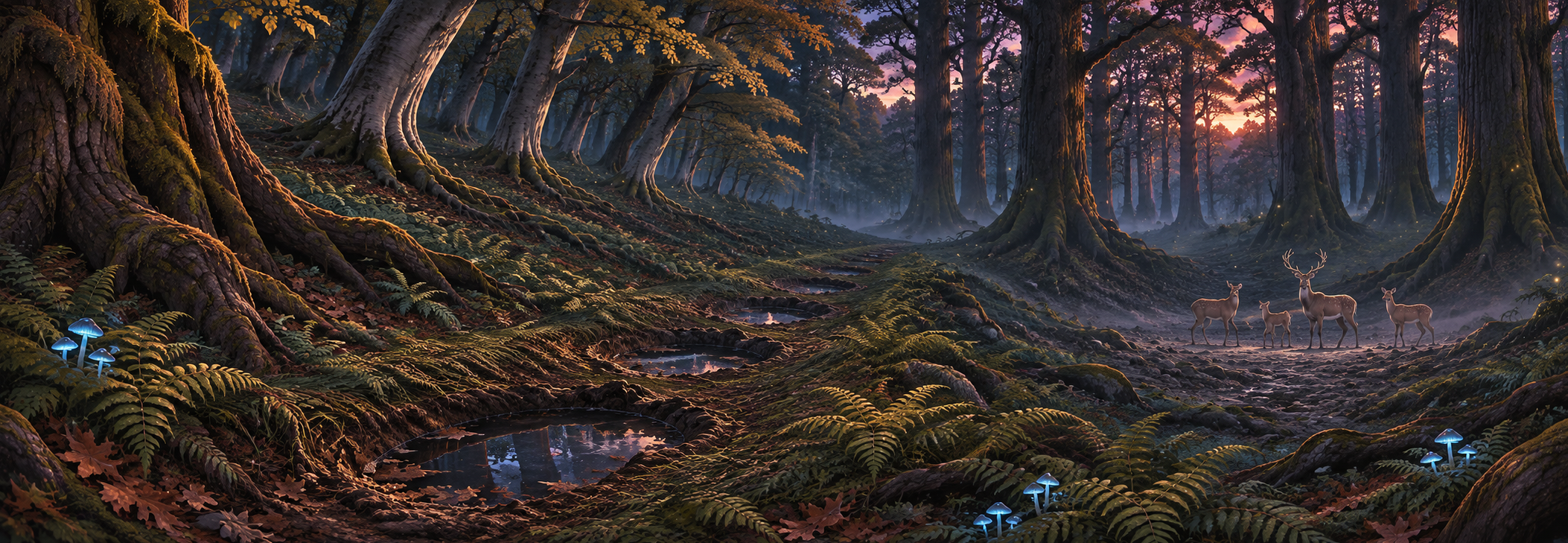
They came over a rise and there were deer in the dry bed of the seep below them, standing close with their heads up and their mouths shut. The buck at the front had leaves in his mouth that he hadn’t chewed. None of the deer looked at the two of them. They were all looking at the same patch of dusk, down the slope and to the right.
She went down to the nearest doe, because she was who she was, and put her palm on its side. The doe’s heart was going so hard it shook the hair on its flank, and it did not move a muscle.
“Noëlle,” said Crispin, very low.
“I know. It’s my hands. I can’t help it.”
Along the slope to their right, the beeches were leaning. Every one leaned away from the patch of dusk the deer were watching, with its top combed over to one side. The oaks at the end stood dead straight and their leaves hung still in a wind that was moving everything else. The first of the tread came up through her boots and into the bite, which got hot and then cold, and she took it for her own pulse.
The second one came a long time after, and it was not her pulse. The leaf litter at the foot of the slope gave under it a little, a mattress sinking when someone sits down on the far side of the bed. A band as wide as a cart sank in the ferns. They lay down in it, and cold water began to come up through the hole where they had been.
Between the trunks, one stretch of the dusk was darker than the rest. It moved. Where it moved, the trunks behind it went out one at a time and came back after, in order, from left to right, slower than she could have walked. She couldn’t have said how big it was. She could only have said how many trees had to go out.
All summer she had been the one person in the valley who was not afraid of the forest, and she had been smug about it. She was afraid now. It was an educational feeling, and she did not care for it.
Crispin had put himself downhill of her, square, with his arms out from his sides and his ears pinned so hard that the pale inside edge of the left one shook. He looked at the empty dusk where it was. His arms came down.
“It’s between us and home,” he said. “It’s going the way we came. I can’t go round it before the light goes, and I can’t outrun it, and I can’t... Noëlle, I can’t fight that.” His voice was steady and it was awful. “I’m stronger than anything in this forest. It’s the one thing I’m sure of. It doesn’t matter here, not one bit, and I’ve known it since the frogs.”
She had heard him say a great many things about himself that summer, nearly all of them unkind, and this was the first one she believed. That frightened her more than the trees did. He was the strongest thing she knew of, and he had looked at it and put his arms down.
“Maybe it’ll miss me,” she said. “I’m very small.”
He gave her a look that ended the joke. The moon was a thin rind that had set before the light went, so he couldn’t change, and he said that too, plainly, before she could ask.
“Then where do we stand?” she said.
He turned around slowly and found it: a beech so old that its roots came out of the slope higher than her head, with a pocket between two of them where years of rain had washed the dirt away. He put his hands under her arms and boosted her up into it. He came in after her and sat with his back to the trunk and her between his knees, facing out, and his body across the front of her.
“Stay low,” he said. “Don’t talk. Don’t...” He didn’t finish. His tail came around her ankle and held on. With his thighs bracketing hers and his breath in her ear, some shameless part of her kept track of every place he touched her while the thing came up the slope. She told that part to behave. It paid no attention. It noted his heartbeat against her back, and the heat of his inner thighs through her shorts, and that he smelled, even now, of the den and the stream and himself. It had been keeping track of those things since the springs and saw no reason to stop for a monster.
The light went out of the canopy. She kept her palm on the root, because her hand needed a job. They listened to the thing go by at the bottom of the slope, a long way off and then not as far as she wanted, the tread coming up through the wood, a long while between, and then fading. She let herself believe that was all it was going to be.
It turned.
She couldn’t have said how late it was. There were no stars through the canopy and no moon, and her hand had been on the root so long that she had stopped being able to tell where she ended. It was the root that told her. The tread that had been going away stopped going away. It came up the slope.
She could feel the whole root system by then, which she would have laughed at a week before. Under the slope the old roots of that beech ran out through the dirt in every direction, and wherever a root ran, the ground was firm and the cold went round it. Everywhere between the roots, the ground wanted to give. The firm places were the places the thing would not step.
The pocket they were in was one of them, and the root on the east side of it was hollow.
“Not that side,” she said, and her voice came out hoarse. “That one’s rotten right through. It’ll go. Come this way.”
He didn’t ask how she knew. He moved, with his hand in the small of her back, around the trunk to the west side and settled them against a root as thick as her waist, and that one held.
He had taken her hands over his own eyes, in the dark, with that thing on the slope. Nobody in Angeau had ever trusted her hands without wanting something from them. She put that away to cry about later, when there was time.
He was shaking, though he fought it, so hard it came through his chest into her teeth. A sour, sharp smell of fear was coming off him while the thing came up the hill.
She took the cloak off her shoulders and pulled it around the two of them, and over his head. She pulled the hood up to cover his ears. Nothing told her to. The cloak did what wool does, which is hang there until somebody picks it up. She picked it up and put it on him before she put it on herself. She would have liked to call that courage, but she knew better: she couldn’t stand to watch his ears. They were hot in her fingers as she folded them down under the wool, and he made a small sound she would have given a good deal to hear somewhere else.
The cloak was hot, hotter than two bodies could have made it, and she held on to that and told herself it was only them. Under the hood it smelled of resin and beeswax, the same as the salve in her pocket.
The sound stopped, in a line again. It came up the slope toward them and passed over the root, the cloak, and the two of them, and then there was no sound at all, not an insect, not a branch, not the ordinary noise a body makes when it holds its breath.
The ground gave in front of the tree, leaf litter sliding into a hollow that had not been there. The smell came in so thick that her eyes ran. It came up the slope with the trunks going out in front of it, one and then the next, until it stood at the foot of their tree and the last trunks were out, and she could not see the beeches she had seen all night.
It stopped.
The bite was so hot she thought the skin would lift. Against her side he flinched at the same moment, and his hand came over her wrist and shut. Under the hood his ears were pressed against her jaw. His heart hammered through his ribs against her shoulder blades, and her body, which had no sense, leaned back into it. Her own hands, which did not shake, were shaking so hard the cloak trembled with them.
She did the only thing she knew. She talked to it.
She used the voice she used on frightened things, the one that worked on children and dogs and Crispin. She kept it low and ordinary. “It’s all right,” she said. “We’re only sitting here. We’re not in your way. We’ll stay right where we are, and you can go on whenever you like.”
Nothing answered, and she hadn’t expected it to. The cold stopped at the edge of the hood, along the line where the red wool ended, and did not come in.
She counted, because that was what she did at a bedside. She lost count somewhere past where she would have been comfortable. The tread didn’t come, and the cold stayed where it was, and Crispin’s hand stayed shut on her wrist. It had to know they were there. She had been calling the cloak luck since the day a branch of thorns swung off her hood, but she couldn’t call it that any more. She put her forehead down against his arm.
She thought about who else she had ever seen walk through the deep woods with the woods keeping quiet around her, and there was only Nana.
She thought it, and she didn’t finish it, and she put it down. She would get there in the end, at a door with roses on it, and she would not enjoy being the last to know.
The tread came again, a long way up the slope, going away. It came less often, and farther apart. The cold at the edge of the hood stayed for one more breath and was gone. As the sweetness thinned, she could taste copper where she had bitten her cheek.
The first frog started at the seep. It was one frog, and then another frog answered it, and then a whole hillside of them.
She took the hood off his head. The sky through the canopy was gray and the beeches had come back, all of them, every one standing where it had stood.
Crispin hadn’t let go of her wrist. His ears came up slowly. He looked past her, down the slope to where the thing had stood, and then at the hem of the cloak, and then at her. He shut his mouth on whatever he had been about to say.
“What?” she said.
“Nothing.”
“Crispin.”
“I’m... cold.” His ears went down. He knew something and wouldn’t say it, and he wouldn’t lie to her either, so she let it be. She had grown up in a town full of people who lied to her kindly, and a boy who would rather say nothing than say something false was rare enough to wait for. Her hands were the ones still shaking. She slid them under the hem of his shirt to warm them, for his sake, she told herself, and his stomach jumped against her knuckles. He caught his breath. He didn’t move her hands.
“You held still,” she said. “I’ve watched you hold a tree. That was harder.”
“I did nothing.” He said it into her hair. “I couldn’t do anything. I was supposed to be the one who...”
“You were,” she said. “You were right here.”
She meant it more than he would believe. He thought he was only worth something when he was useful, and she knew a little about that herself. He had sat all night between her and the worst thing in the forest with nothing to fight it with, and he was ashamed of himself for not punching it.
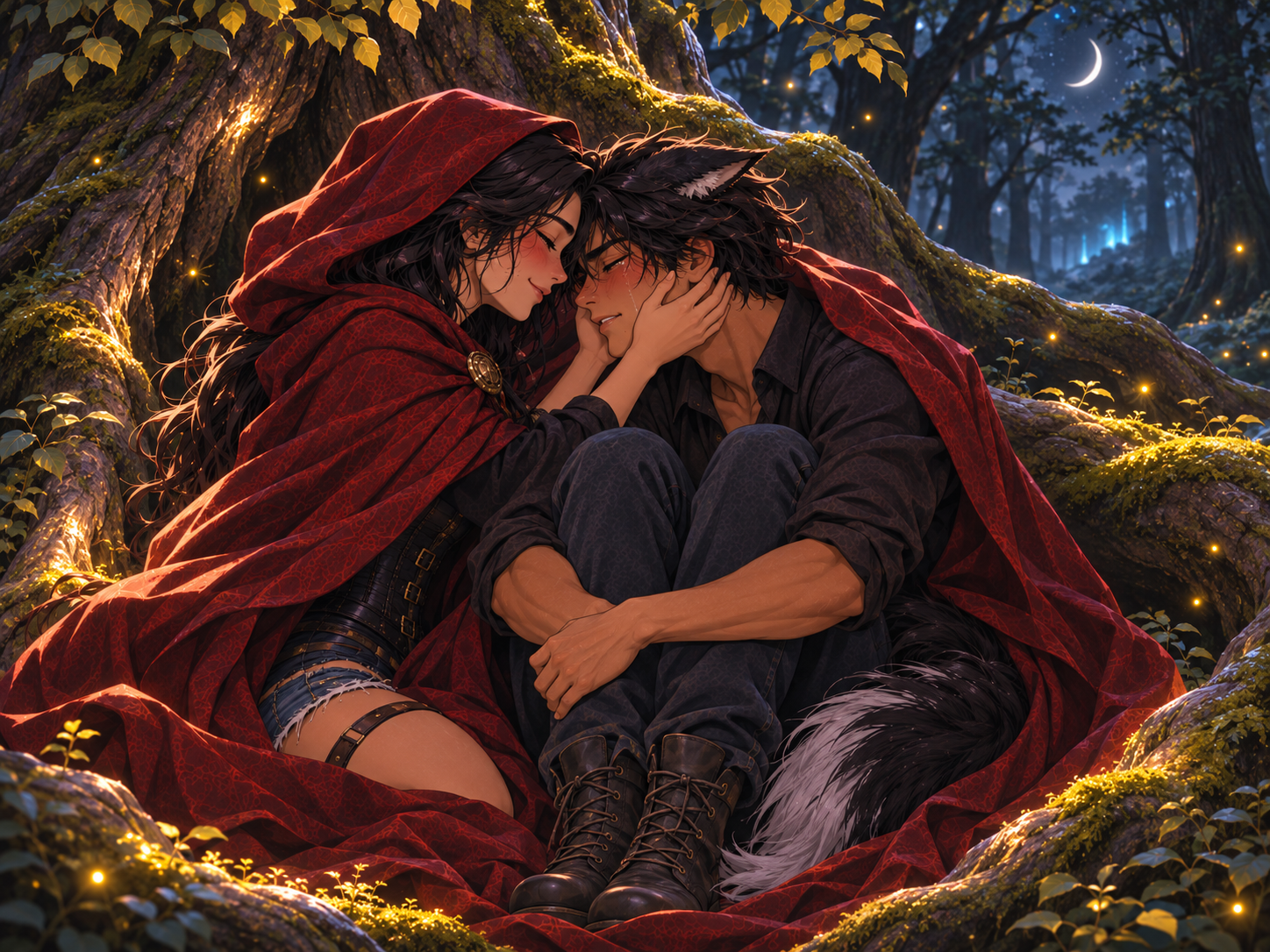
When she kissed him then, once, in the roots of a tree that had held when everything around it gave, his tail wrapped twice around her leg. “Nana’s going to hear about this,” she said against his mouth, and his ears jumped, and she let that go too.
He kissed her back a second time, with one hand gone into her hair and the other on the bare skin over her hip, where her shirt had ridden up. For a moment neither of them was listening to anything. He left the hand there. It was warm and very large and not going anywhere, and she was alive, and so was he, and if the wood had given them a little longer she would have used it.
He heard it before she did. His ears swung south, away from where it had gone and down the long slope toward home, and stayed there. A breath later the wind brought it to her: pitch burning, a great deal of it, a long way off, and under that the drag of a file on metal. She had grown up in Angeau. She knew what that much burning pitch meant there, and what a file on metal was for.
They sat in the roots with the cloak still around both of them and their faces turned back the way they had come.